

Appalachia by Ear
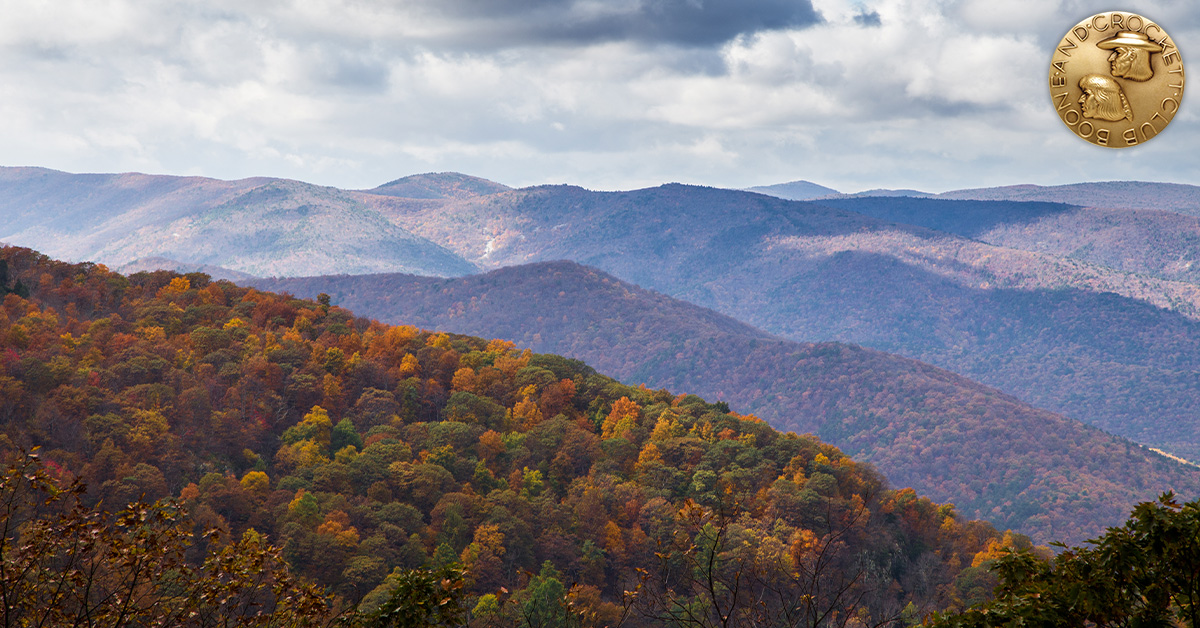
When the weather and the wild write the music of a hunt
By J. Shane Townsend, Photo by Chris Johnson
In the fall, music in Appalachia changes. Hickory nuts drop in thuds. White oak acorns fall in smacks, sometimes bursts. Turkeys scratch. Bluejays comment. Squirrels protest. And music is all around.
So when I had the chance to hunt 400 acres of mountain and farm near Virginia’s Blue Ridge Parkway, I knew just how I’d do it. I’d play it by ear. No electronics. No gadgets. And since my phone is my timepiece, without a watch. And I’d do it with my recurve bow. My compound bow was a perfectly engineered eight-pound obstacle to how I wanted to hunt, so I gave it to a buddy and bought a two-pound stick.
And my plan for the day was three distinct hunts. By 5 a.m. I’d hang my saddle at the head of a drainage and catch the deer moving back to bed. Sometime mid-morning I’d work my way up the north side of the mountain into the falling thermals, slipping and listening. Then mid-afternoon I’d drop down low to a fence gap between mountain hardwoods, grass and scrub, and apples. That’s where I’d end the day.
And if plans were bread the world would be well fed.
At about 3 a.m. I turned west and George Jones had me singing so hard that I overshot my turn. So I turned around, turned off the radio, and turned my attention to the day.
The tailings of a Gulf Coast hurricane were headed my way, so I considered what effect the wind and rain might have on the deer and how it might compel acorns out of the trees and how the rhythm might attract bucks and bears. Rather than chasing coordinates on my mid-day hunt, I’d chase drumbeats. By the time I put the truck in park I was ready to run.
Half a hundred steps and the slope had relieved me of that inclination. I’m a trad hunter now—an older, wiser, calmer, better human, and so on. And out of breath. Only half an hour later than planned, I sat in a tree I guessed would be good.
No wind blew. Hooves punched through dry leaves as one then another deer eased in and bedded. And I sat in the dark listening.
In the first light, the sounds of hooves grew louder. By accident I’d set up about five steps from a heavy trail. Step. Step. They were coming. So, I stood and readied the recurve. And as I did, a tractor—undoubtedly the world’s oldest and loudest tractor—pulled up growling and sent deer running. Two, three, four does, and a forky ran down the trail at my feet. They did not stop. And the technology that feeds us put an end to my morning hunt. But a farmer’s got to farm.
I reached for my phone. Remembered. Sat and figured. It must have been around 11 a.m. because the thermals were shifting. Normally, I’d be checking the clock or monitoring my progress and plans against OnX pins. I’d covered ground and climbed a thousand feet, slowly, scratching leaves with a stick, calling a little, doing my best turkey. Glassing. Watching. Mostly listening. And the music high on the mountain was its own. Leaves were drier, more resonant. Hickory nuts fell harder. Acorns dropped like the white oaks were slinging chicken feed. Squirrels bounced along. Pileated woodpeckers and crows and ravens and blue jays traded riffs.
If you’ve ever heard a wet break of a green limb you’ll know what I heard. When the sound called again I had to go. And I worked my way slow. Scratching. Stopping. Listening. Then there it was. In the top of a 90-foot white oak. A black patch.
I would like to say that I remained perfectly disciplined. That I sat and glassed and studied and thought. I did not. I was at 15 steps when a roughly 90-pound bear hit the ground in front of me. Leaves and limbs and bark cracked and tore and snapped and rained. Another bear about the same size. Half a beat later about a 200-pound bear right behind. And as they tore a trail through blowdowns and thicket I listened. I scratched leaves away from the foot of a tree and I sat, grinning and grateful to have seen such a thing. Acorns rained. A nearby deer blew at my intrusion. A while later, when the blue jays screamed and squirrels bounced and fed in sounds like grinding quarters, I slipped down the mountain.
By the midafternoon, I had made it to that low spot, and was sitting in a tree. The remnants of the hurricane had turned my perch into a cradle and with each gust the tree swayed and I rocked listening only to the rain and watching the X just eight steps away.
Deer, I thought, would come down the mountain and walk through the hole in the fence at my feet to get to the apple orchard.
I was barely hung when a spike came out of the spot I had imagined. But he moved off in the opposite direction. Something snatched my head around. Behind me in the orchard two big old leathery does and two fawns were looking up toward me. And when I finished swearing, I laughed. An old doe will beat you even at your best, even without the distraction of a phone.
Wind rose. Rain fell.
When the wind hit the leaves like cold waves onto the beach I zipped my fleece and studied the apples—apples on the ground, apples in the trees somehow glowing. And in the slow of the moment I realized I’d dropped my shooting glove. Moments later, a gust sent my arrow off my bow. It stuck in the ground at my feet. When I placed a new arrow on my string I discovered the serving had unraveled and wouldn’t hold a nock. So I tore a piece of thread off my pants and wrapped it well enough to work for one arrow.
When a cardinal burst from the wood line to my right I knew something was coming. Raised my bow. Antler. I pulled into my string.
That spike stepped out. He walked over and stood under me. Another deer moved at the wood line.
Doe.
And in the last hint of light, a dark form emerged from the oaks and stood and watched and smelled and, I imagine, like me, he listened.
Then the dark covered us all.
And the only music played in the wind and rain.
J. Shane Townsend writes about people and nature for many outlets. His book Black Bear America: Conflict, Coexistence, and the Stories We Tell of Our Wild Neighbor (GlobePequot) will be out next year. Find him at ShaneTownsend.com.
Hunting Unplugged
We know that woodcraft and self-reliance remain the cornerstone of traditional hunting. That’s why we’re featuring stories in this section called Hunting Unplugged. These stories come from hunters who intentionally leave cell phones, Smart watches, GPS units, and electronic aids out of the field, relying instead on experience, landmarks, and maybe even a little Kentucky windage. Others detail the experience of stepping back into the woods without modern technology for the first time, which reduces the clutter and creates stories without distaction. If you have an unplugged story to share—or know someone who does—please send your submission to [email protected].