
Competition Even in the Wilderness—Sharing the Bounty
12 page preview of Wilderness Journals
By Jack Ward Thomas
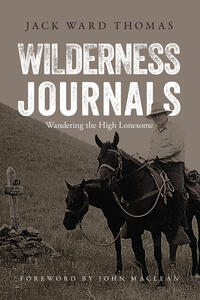
Lack of significant rainfall in the mountain West for the previous two months was setting the stage for the worst fire season across the region since 1910, the year of the infamous “Big Burn” in Idaho and Montana. At the time of this trip to the Eagle Cap Wilderness, the Summer of Fire had barely begun, and the scattered wildfires burning in the Greater Yellowstone Ecosystem seemed to pose no serious threat—not yet.
July 28, 1988
There was a chill in the air at dawn—a contrast to the dog days of summer down below in the valleys. On the slopes above the meadow a mule deer buck, a four-pointer with his antlers in velvet, was grazing in the snow-slide area. If he stays up this high when the hunting season comes, he has a good chance to survive another year and grow even bigger antlers. As I would be hunting elsewhere, I wished him well.
As we sat around the campfire and sipped steaming coffee, Bill and I plotted an imaginary stalk on the big buck. In the end, we concluded that our chances of getting a sure shot at him—the only kind a principled, disciplined hunter should take—lay somewhere between very slim and not much. If it were hunting season, we would damn sure give it a try. An old poker player’s admonition came to mind: “no guts, no blue chips.”
The tree species that survive and prosper above 7,000 feet evolved over the millennia to withstand strong winds and heavy snow. Limber pines are so flexible that their smaller limbs can actually be tied in knots without breaking. So when they are weighted down with ice and snow and the high winds come, their branches bend rather than break; they spring back to shape to catch the rays of the sun when the warm days come. On steep terrain the trunks of both the limber pine and the subalpine firs sweep downslope (from their roots having been bent with the snow) until they have bulk and the strength to withstand the pressure. Then they grow upward toward the sun to fulfill their destiny. Maybe there is a lesson here, a secret to living and achieving in a harsh environment: bend when it is essential to survival; then, when time and circumstances are right, reach for the sun!
We rode up the trail from Echo Lake, past Traverse Lake, to the pass over into the Minam River drainage. The view from the top of the pass was spectacular. Wilderness stretched out in every direction as far as the eye could see. One of the packhorses had to be repacked, and the effort of boosting the eighty-five-pound packs produced some huffing and puffing. In the thin air at 8,500 feet, it does not take much exertion to cause even a strong man to suck for air.
Just over the summit, we encountered a significant snowdrift burying the trail. We debated whether to attack the drift with the shovel or buck the horses through or retreat the way we had come. But we believed the drift likely covered a switchback in the trail. To miss the switchback and go off the trail could well be a serious, perhaps fatal mistake. Fortunately, when Bill gave the lead horse her head, she picked her way through the drift and negotiated the switchback without missing a step.
Then Meg’s horse, Kitty, who was bringing up the rear, balked. This was neither the time nor place for Meg, a relatively inexperienced rider, to dispute the judgment of a recalcitrant horse. With Bill sitting on his mare twenty or so feet directly above her, Meg listened carefully to his firm instructions. She stepped off the horse on the uphill side, tied the reins to the saddle, worked around the mare, took the lead rope, and scrambled up the trail that had been broken through the drift, leading Kitty. If Kitty had pitched a fit and gone over the side, she wouldn’t have taken Meg with her. But Kitty deemed this new arrangement a decided improvement and came right along behind Meg without a hitch. There was one thing about Bill Brown—the old horse soldier knew horses!
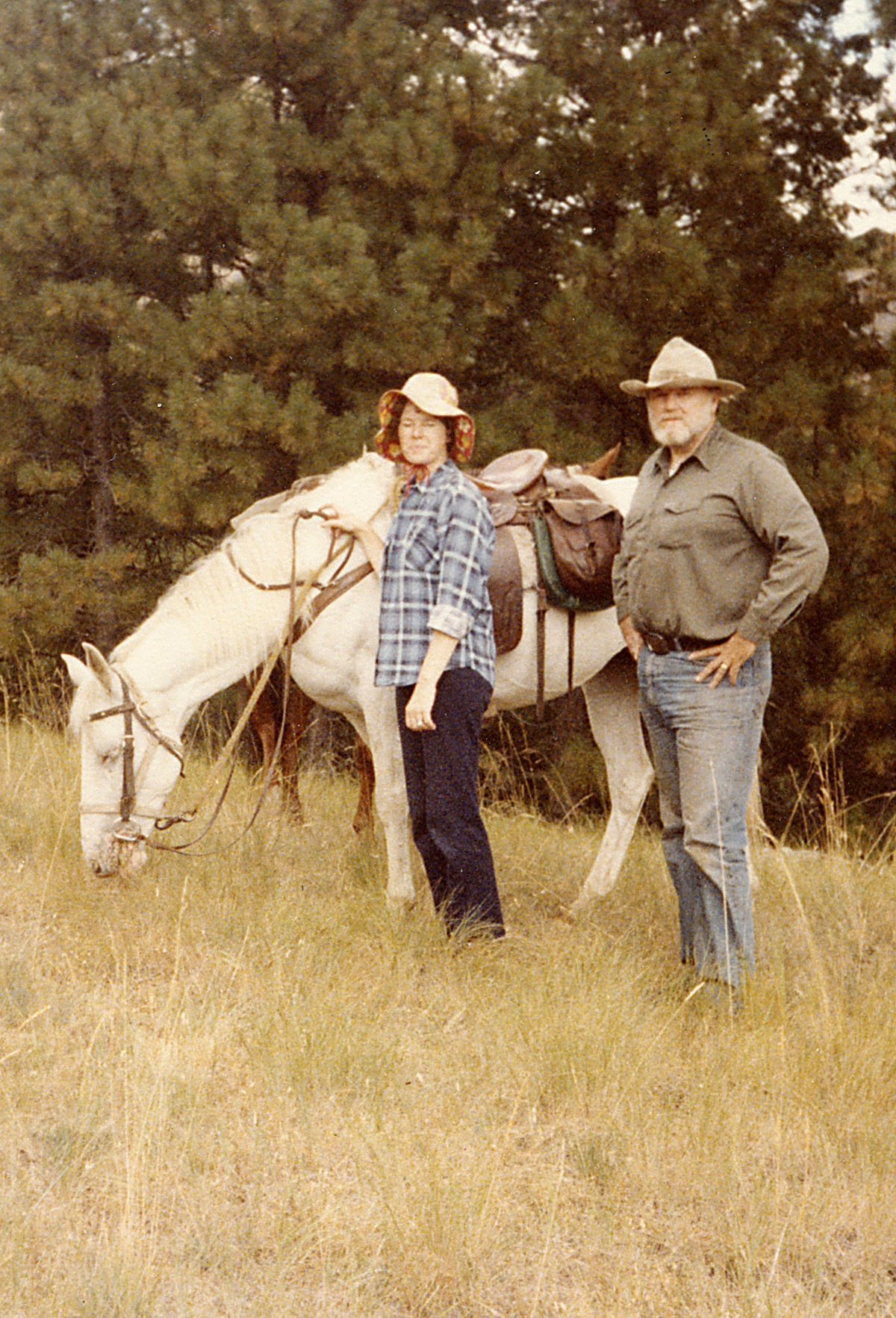
The trail to Trail Creek dropped 1,600 feet in elevation in five trail miles that switched back and forth across the open granite slope. Some stretches through the boulder fields had been blasted out, and a tread of rocks had been laid down by trail crews. While today’s trip covered only eight miles, it included a climb of 1,500 feet and a descent of 1,600 feet and took a bit over four hours to accomplish. Later examination of a detailed topographic map revealed that the distance between our beginning and ending points, as the crow flies, was a bit less than two miles! Where was a straight-flying crow when you needed one? We picked out a camping spot at the edge of a beautiful wet meadow we encountered just at the end of the switchbacks. A spruce-covered knob in the meadow provided plenty of dry wood and flat dry ground for our tents. The meadow itself was covered with green sedges sprinkled with wildflowers. Behind the meadow was the granite slope that we had just descended, gleaming white in the afternoon sun.
Bill set the first shift of horses loose to graze near the stream while I sat cross-legged in the meadow with my senses filled to overflowing. I watched and listened and felt without speaking. Meg’s call to supper brought me back into focus. As we ate, a mule deer doe joined the horses in the meadow to graze, hanging around at the edge of light from the fire until Meg went to bed. I loitered by the dying fire for another hour, alternately staring into the fire and into the clear night sky that was alive with stars. As the fire died down to coals and then to ashes, I became chilled and it was time to head for the tent. As I lay there in my sleeping bag and waited for sleep to come, the clanging of the horse bells seemed to be a lullaby, blending in with the wind whispering in the trees and the night sounds.
July 29, 1988
We were on the trail by midmorning and in no hurry, as our objective was the Elk Camp on the Minam River—only three miles down Trail Creek to the Minam River Trail and then four miles down the river to just above the mouth of Elk Creek. It was a leisurely seven-mile, two-hour journey.
The trail from the mouth of Trail Creek to the Elk Camp passed through stands of mature lodgepole pine, white fir, and spruce, with occasional huge yellow-bellied ponderosa pines and larch sticking up above the canopy. Eight years ago the lodgepole pines were undergoing an initial attack by an outbreak of mountain pine beetles. The beetle larvae feed on the cambium layer under the bark, and the tunnels they leave eventually girdle the tree and cause its death. The presence of the mountain pine beetle was advertised by the globs of whitish pitch on the bark.
Now, three years later, the dead and dying stands of lodgepole pines seemed an example of the proverbial “wrath of God.” Well over half the trees were dead, gray ghosts amid the green. Pitch tubes on the bark of most of the remaining green trees foretold their almost certain deaths.
Many of the dead trees had blown down as their decaying roots gave way, forming jumbled jackstraws of tree trunks. Young spruce and white fir trees were plentiful and racing the seedling lodgepole pines for the sunlight. The skeletons of the lodgepole pines lying on the ground were decaying and would eventually, after many decades, melt into the forest floor, providing nourishment for the new stands of trees just poking their heads up through the jackstrawed trunks. And, thus, death becomes the facilitator of new life.
I wondered, does any living thing ever really die? Or do the elements simply reconstitute themselves and appear in other life forms? Is that not a form of immortality?
A forester focused on the production of wood for use by humans would view this scene, especially the mess of dead trunks, and worry that fire could wipe out the newly developing stand. The forester’s job would be to minimize the chance of fire, assure dominance of the desired tree species for the site, manipulate the stand to enhance wood production, and harvest the result to be made into wood products to satisfy human needs. In the event of a fire, young trees would eventually spring forth from the ashes—this time in a stand dominated by lodgepole pines. The process, repeated so many times before, would continue.
I am still learning more about natural ecological processes in my wilderness wanderings than I ever learned from textbooks or from observations of forests managed to maximize wood production, though such experiences were certainly instructive. Human societies need wood—and a lot of it—to sustain economies and provide for human needs. But we also need places to observe and learn from natural processes before we become too limited in our understanding of natural systems and too dependent on knowledge gained from silvicultural manipulations.
In wilderness lies some of our last surviving repositories of the natural process, an ecological treasure house analogous, in some ways, to the great library at Alexandria that was destroyed in a conflagration. The loss of that library shut off Homo sapiens from much of the knowledge that had accumulated from earlier civilizations. Only a barbarian could have exulted or been indifferent when the library at Alexandria burned. If we stay on track, succeeding generations will be able to speak well of our civilization in our preservation of wilderness as a library of natural processes.
When we arrived at the very faint trail that marked the turnoff to the Elk Camp, Bill’s mare, Manita, with no guidance, turned off the trail and led us on a short journey through dead, downed lodgepole pines so dense that it took nearly a quarter hour for her to pick her way 200 yards or so to the bank of the Minam River. When we rode into the campsite, we encountered a genuine mess—a painful desecration of a beautiful spot.
Since our last visit, the camp had been discovered by slob elk hunters. There was a very large fire ring festooned with dozens of burned cans and broken glass. Deep drainage ditches that had surrounded three large tents had been left unfilled. Three meat poles hung between the trees. Tent poles were scattered helter-skelter. Horses had scraped away the soil and exposed the roots around the trees where they had been tied—evidently day after day. There were hides and bones from several elk. A pile of garbage, including a half-dozen fuel cans and gas canisters, had been scattered about by scavengers.
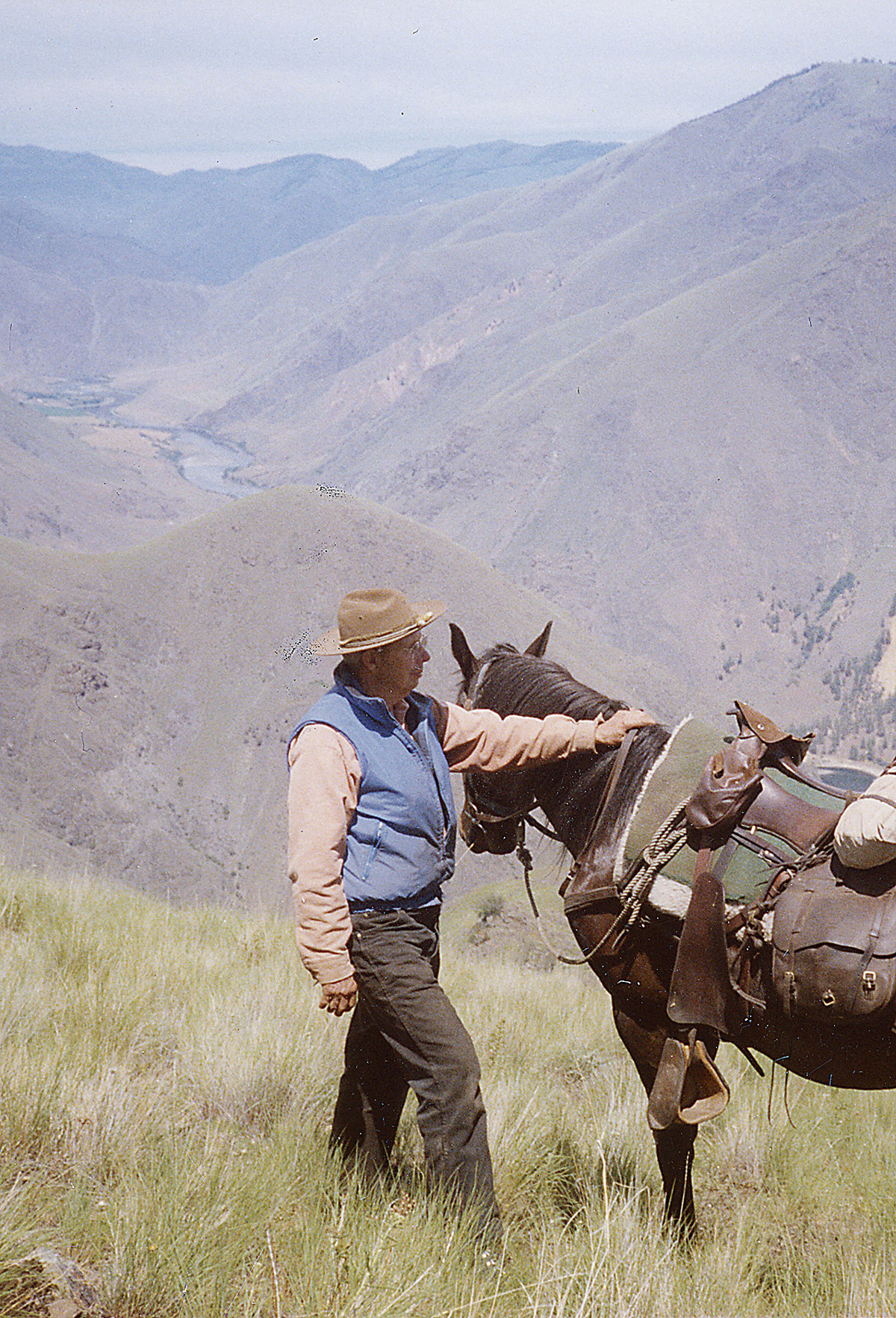
I saw some anger but mostly pain on Bill’s face, much as would be expected upon discovering desecration of a treasured shrine to a dearly beloved. This was just such a place, a shrine of sorts for him. Without comment, we simply dismounted, tied the horses, and went to work to repair the damage. There wasn’t much talking in the process.
Bill and various companions had camped in this place, off and on, for four decades and left almost no trace. So had most parties of hunters in the Eagle Cap. Yet there were too many of what Bill called “half-ass hunters” who do not come to such places as this to be one with the wilderness. They come to take, to use selfishly, to “conquer.” That is not the pity so much as their not being open to learning the lessons and the code of conduct that wilderness demands and is intended to convey. And then they leave behind their desecrations as a token of their passing and perhaps their contempt—or, just as likely, their abysmal ignorance. Perhaps all of those despicable characteristics come in a single package.
We spent half a day policing up the area and repairing the damage as much as we could before we set up our camp. To get back into the spirit of things, I declared tonight to be “fish night.” Fly rods were quickly readied, and we were off on our separate ways to make it so. In little more than an hour of dedicated fishing, I landed some twenty rainbow trout and two Dolly Varden trout. I couldn’t remember the legal limit, but two fish per person for supper seemed about right, so I kept the eight largest fish I caught—six rainbows and two Dollies.
While I was fishing, I saw a large battered salmon, more dead than alive, drifting slowly downstream with the current. Patches of scales were missing from the midpoint of its back to the tail, and its fins were tattered. I hoped the dying fish had accomplished what it had come so far from the Pacific Ocean to do: reproduce its kind. It had been on a hazardous 500-mile odyssey journey upstream from the Pacific past fishermen, gill netters, and eleven dams to reach its ancestral spawning grounds here high in the Eagle Cap Wilderness. Such a life force commanded appreciation and respect. I caught myself in the process of a salute—a throwback to my military days, I guess.
When we met back in camp, I asked Bill, “What’s the limit?” He replied, “Two per person for supper.” That made two of us who didn’t know the legal limit but had figured out a commonsense solution. The total of our ignorance produced what is known in northeastern Oregon as a “fish feed”—local parlance for a no-holds-barred gastronomic orgy. In the midst of our fish feed we were joined by a camp doe of the mule deer persuasion, which appeared just in view, off and on, until we doused the fire for bedtime.