

Meet Dr. James “Jimmy” Cain: The Dr. Red Duke Boone and Crockett Chair in Wildlife Conservation and Policy at Texas A&M University
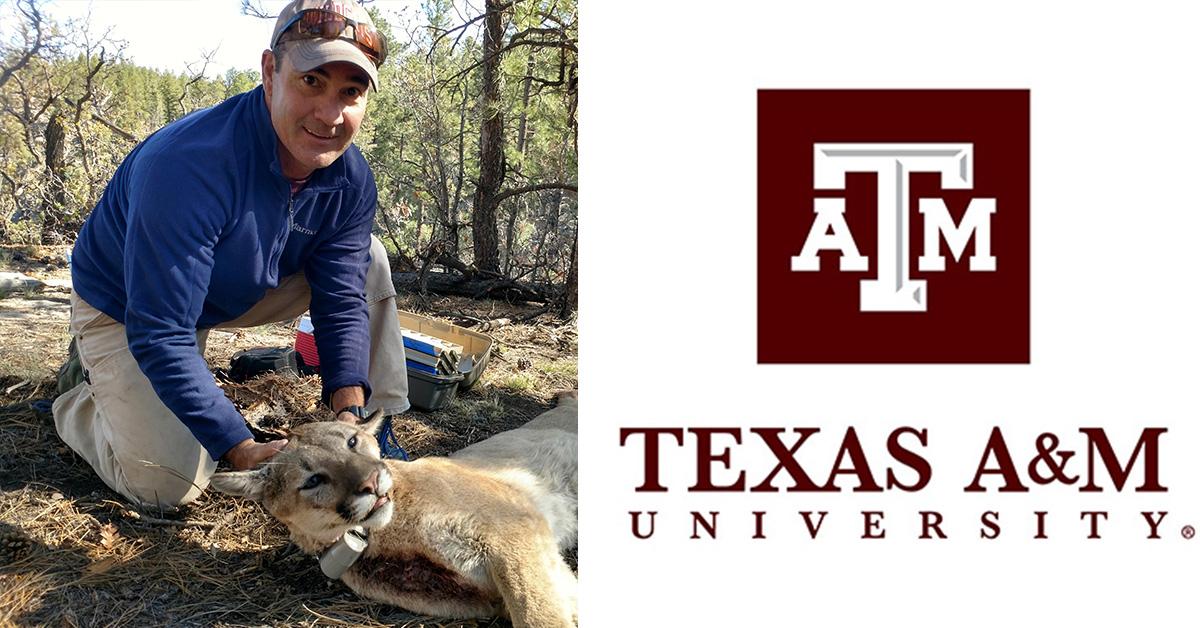
By PJ DelHomme
From studying desert bighorns to mentoring the next generation of researchers, Dr. Cain’s career is defined by research that informs real-world wildlife management.
The Boone and Crockett Club is pleased to announce that Dr. James “Jimmy” Cain has been hired as the Dr. Red Duke Boone and Crockett Chair in Wildlife Conservation and Policy at Texas A&M University. Dr. Cain joins the Department of Rangeland, Wildlife and Fisheries Management (RWFM), bringing nearly 16 years of experience at the U.S. Geological Survey (USGS) and a research background spanning the arid landscapes of the American Southwest and the floodplains and savannas of southern Africa. The Dr. Red Duke Boone and Crockett Chair at Texas A&M is part of the Club's larger University Programs, whose mission is to develop a diverse community of high-impact wildlife conservation leaders.
Dr. Cain’s appointment marks a significant addition to the Texas A&M faculty. His research focuses on wildlife-habitat relationships, population ecology, and the influence of management practices on native species, particularly large mammals in arid and semi-arid environments. Prior to this role, Dr. Cain served as the Unit Leader of the USGS New Mexico Cooperative Fish and Wildlife Research Unit and an Affiliate Professor at New Mexico State University.
Throughout his time at the USGS, Dr. Cain focused on providing what he terms "actionable science"—research intended to assist wildlife managers in making management decisions, developing new policies, or evaluating the effectiveness of existing ones. By providing this data to state and federal agencies, he has helped support the scientific evidence they use when presenting policy changes to agency leadership, legislators, and the public. This background in linking research to management outcomes aligns with the Boone and Crockett Club's objective of ensuring that science remains a primary driver of conservation policy.
Honoring the Legacy of Dr. Red Duke
Dr. Cain’s chair position is named in honor of Dr. Red Duke, a pioneering trauma surgeon and dedicated conservationist. Dr. Duke was a former president of both the Boone and Crockett Club and the Wild Sheep Foundation, and he was a key figure in the reintroduction of bighorn sheep to West Texas.
Dr. Cain’s doctoral research at the University of Arizona focused on the impacts of water developments on desert bighorn sheep in remote southwestern Arizona. Over four years, he navigated the Cabeza Prieta National Wildlife Refuge, conducting research that challenged some long-held assumptions. He found that while water is essential for sheep survival, it cannot protect populations from severe drought when forage conditions are inadequate. His research was supported, in part, by several grants from the Boone and Crockett Club between 2001 and 2003.
A Foundation Built in the Field
Long before Jimmy Cain became Dr. Cain, his life revolved around water and the desert. After graduating from high school in 1988, he spent three years working in landscaping and irrigation in the Phoenix area. Note: He still installs his own home irrigation systems.
His interest in the outdoors was fostered early by his grandparents, who took him camping and fishing for bass and crappie in Arizona’s reservoirs. By high school, he and a friend took backpacking trips, riding the Greyhound to the Mogollon Rim to hike and fish on the weekend.
Eventually earning a B.S. from Colorado State University in 1997 and an M.S. from California State University, Sacramento, Dr. Cain completed his Ph.D. in 2006.
He pursued a postdoctoral fellowship at the Center for African Ecology at the University of the Witwatersrand in Johannesburg, South Africa. While working in Kruger National Park, he studied interactions among African buffalo, zebra, and sable antelope. This research focused on the interactions associated with water hole development. The introduction of artificial water holes (so tourists could more easily observe wildlife) had inadvertently altered the local ecology by allowing water-dependent species to encroach on the habitat of rarer antelope species, subsequently drawing in larger lion populations.
Upon returning to the U.S., Dr. Cain served as an Assistant Professor at Texas A&M University-Commerce before joining the USGS in 2010. During his tenure in New Mexico, his lab tackled some of the region’s most complex conservation challenges, including:
- Mexican Wolf and Elk Interactions: Evaluating how the recovery of Mexican wolves influences the demography, behavior, and habitat selection of elk populations.
- Pronghorn Movements: A three-year project identifying how rangeland infrastructure, specifically fences, creates barriers that prevent pronghorn from accessing vital forage pulses in the Chihuahuan Desert.
- Mountain Lions and Black Bears: Studying the abundance and ecology of these predators to assist state agencies in setting sustainable harvest limits.
New Research Frontiers
As he transitions to his new role, Dr. Cain is hitting the ground running, with a potential study on the desert bighorn population in the Franklin Mountains near El Paso, in collaboration with Texas Parks and Wildlife. In addition, there is the unique challenge of wildlife management in Texas, where only three percent of the land is public. Dr. Cain will likely lean on his experience in South Africa—where private landowners play a central role in wildlife management—to help him build new networks with Texas landowners and state agencies.
For Dr. Cain, the most rewarding aspect of his career remains his students' success. Over the years, he has mentored dozens of graduates who have gone on to leadership positions in state and federal agencies. “When students are young, they often want to focus on the biological 'fun stuff,'" Dr. Cain noted. "But the goal of this program is to help them realize they can have a much larger impact by influencing policy at a broader scale.
“Seeing a student I mentored 12 years ago now making high-level decisions for an agency is incredibly rewarding,” he said.