

Shadows of the Peloncillos
By Kevin P. Bagley
In the heat of the creosote flats and the silence of the rimrock, the reintroduction of the desert bighorn comes full circle.
I retired in May 2023 and found out in June that I had drawn a desert sheep tag for the Peloncillo Mountains in southeast Arizona, along the New Mexico border. Creosote flats surround this mountain range. The southern half of Arizona is hot and potentially dangerous from June to August if you are unprepared. The exception to the heat is the annual monsoon, which cools things down with afternoon cloud cover and rain. My scouting trips would be solo, but my family would join me for the hunt. My first of seven trips was a Friday to Monday in August, when the forecast high was 100°F. The goal was to travel around the Peloncillo Mountains, learn the roads, determine public access, and hopefully find sheep.
When not out scouting, I got in shape hiking the Wind Cave Trail, a three-mile round trip with 850 feet of elevation gain, at Usery Mountain Park. On the Sunday evening of my first scouting trip, I returned to the starting point. It was too late to glass, with the sun already below the horizon, but I’d be in position for Monday morning. As I drove looking for a camp spot, I passed two trucks together, which I assumed belonged to sheep hunters. I waved and continued another quarter mile to a decent camp spot. As I was setting up camp and preparing dinner, one of the trucks stopped. The driver introduced himself as James Blue and told me the other truck, which had driven in the opposite direction, belonged to Matt Holcomb. They’re friends who occasionally meet somewhere in the Peloncillos to watch sheep. Matt guides in this area for Sam Dieringer of Dieringer Outfitters. They did not have a client for the upcoming hunt. Monday morning, I glassed my first sheep—a herd of 12. What a great start.
This hunt wouldn’t have happened without the sweat equity of the Arizona Desert Bighorn Sheep Society, which partners with the state on critical projects like the water catchments I glassed during my scouting trips. They also raised money to help fund these transplants, along with the Wild Sheep Foundation. It takes a village of biologists, pilots, and volunteers to put a ram on a mountain.
James passed my contact information to Matt, and two days later, we talked. A little advice from someone who has gone through this: don’t have a 7 p.m. conversation with a guide, or you’ll be wide awake at 3 a.m. I had researched the past sheep harvest data for this area, and it turns out Matt had guided for the two biggest rams. The Arizona Game and Fish Department (AZGFD) recorded green scores of 189-3/8 and 186-6/8 for the two.
I’d never hired a guide before. Would it be okay to participate in scouting? Would it be acceptable to have six people in camp, with four of them along on the hunt to watch? I’m not a trophy hunter and would be perfectly happy with a quick, one-shot kill on a mature 160-ish ram. I wanted an experience—to learn the hunt area, sheep habits, habitat, and why they are here but absent in other sheepy-looking areas. Matt welcomed me to join them in scouting, expected others to join me for this once-in-a-lifetime hunt, and suggested we pursue the biggest ram we knew about. Sam and Matt would be my guides for this hunt.
Things happen along the journey that you couldn’t predict. My brother Tom was on an out-of-state deer hunt in Idaho. At a gas station in Burley, Idaho, he struck up a conversation with someone else pumping gas, who turned out to be Bradford O’Connor, the son of Jack O’Connor. They were invited to Bradford’s and his wife’s hotel room, where they talked about hunting for two hours. Bradford had been invited on a commemorative antelope hunt out of state and was returning home. My brother had a copy of Sheep and Sheep Hunting by Jack O’Connor with him and had it signed. He got a photo holding Jack’s famous .270 rifle. I was loaned the book, even though I told Tom I own a copy. It turned out to be good luck, with its lineage back to Jack.
Following Waldo
On my second trip, I joined Matt in the Peloncillos. He shared pictures of rams, and one in particular was special. James named him Waldo after Where’s Waldo? The ram became the focus of each new scouting trip. Sam had pictures from the previous year, and Waldo was one of the top rams in the unit, with long horns. He stood out among the herd. Ranchers I met in the area knew Sam, and he had helped them with lion problems on their properties. This allowed him to keep tabs on the desert sheep while chasing lions.
The scouting trips were fun. I saw bear, deer, javelina, Mearns and Gambel’s quail, sandhill crane, golden eagles, kangaroo rats, rattlesnakes, a partial solar eclipse, and one of the second-season sheep tag holders. Two of my trips were solo backpacking hikes into areas not viewable from the roads. The distances to each camp were 1.7 and 3 miles, with the limiting factors being carrying 2 gallons of water and being 58 years old. The trips weren’t too fruitful, but I did see one sheep on each trip—a decent ram and a ewe with a red tag on her right ear. She stood from 11:38 a.m. to 4 p.m. at the top of a 200-foot cliff, just looking out over the country. She didn’t feed, didn’t bed, just stood there. I’d like to know her story.
Matt had business obligations during October, but starting in November, we would begin following the biggest ram, Waldo. October was my time to burn off energy on solo trips. The guides proved several times their knack for relocating sheep, and Waldo in particular. Matt had found Waldo on a Friday in early November, and I joined him on the opposite hillside from the sheep that afternoon. From Saturday through Tuesday, I was on my own, keeping track of him. I’d get up in the dark, hike up the opposing ridge in the dark, and watch him all day. One day, he went up and over, and I wondered if I’d ever see him again. Twenty minutes later, he came down and rejoined the herd. It turned out to be my easiest day. The wind picked up, the herd bedded for three hours, and Waldo stayed bedded in the same spot. It was an enjoyable four days, from sunup to sundown, taking lots of pictures and video through the spotting scope. While I watched the target ram, Matt and Sam had the opportunity to scout a different area to assess backup rams in case Waldo disappeared.
I showed Matt the targets from my .308 rifle, shot at 100 to 400 yards. It’s an off-the-shelf rifle and ammunition that shot a 3-inch group at 300 yards, but I felt it was too sloppy at 400. We took a break on two different scouting days so I could shoot his custom rifles, a .260 and 7mm Rem Mag. He wanted me to be comfortable shooting at 500 yards in case a follow-up shot was required. Both rifles, with hand reloads, shot better than anything I own, so I chose to use his 7mm Rem Mag.
My seventh and final trip to the unit started on a Monday, and I was joined by two brothers, John and Brian. The hunt started Friday, November 17. Matt had watched Waldo on Sunday walk up and over out of view. He was not seen on Monday. If we didn’t see him Tuesday, then Wednesday would be a tough day, with Matt climbing a high mountain on the west, Sam riding horseback from the north, Brian watching where Waldo was last seen, and me driving up a road from the south and then hiking to a vantage point. We got lucky, and Matt picked him up Tuesday evening, not far from where he went out of view Sunday. On Wednesday and Thursday, he went several miles, and Thursday afternoon, in the company of two other rams, he did another up and over. The next day was the opener. We’d followed him for most of the previous two weeks, and he’d covered just shy of 12 miles. Sam and James drove to the north side of a ridge and found Waldo accompanied by another ram. The two rams crossed the valley and climbed to join a herd, then bedded down for the night.
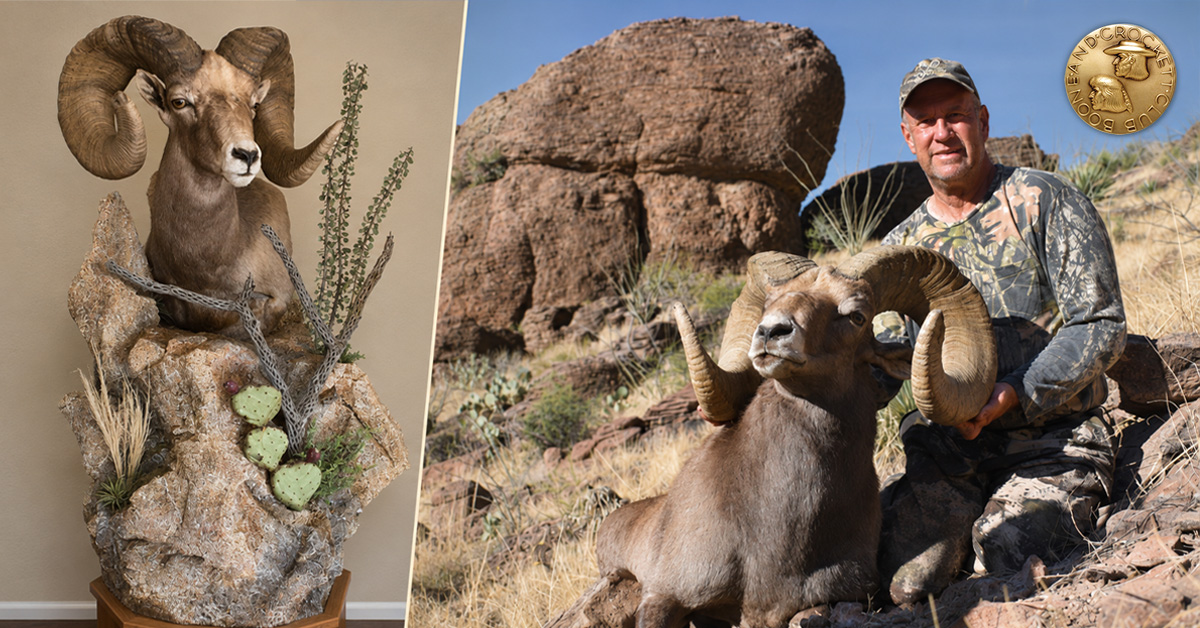
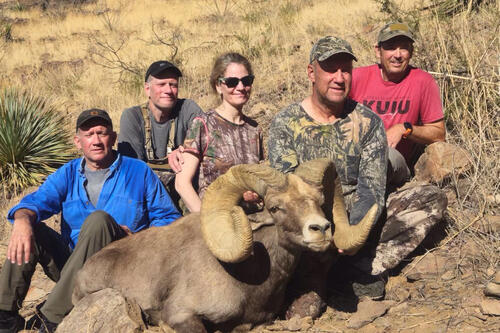
The hunt was short. On opening morning, Sam and Matt glassed him bedded on the bench where he was last seen. Two brothers, Tom and Brian, sister-in-law Leslie, and Brian’s friend Danny were at a good spot to watch the stalk. Matt, Sam, and I would hike up half a mile to an opening in the bench just below the sheep. Sam peeked onto the bench, indicated he saw the sheep, and motioned for us to climb onto the bench and shoot. A 271-yard shot from the 7mm Rem Mag and the ram dropped! It was over. Wow!
The Bighorns Return
Years ago, I found a used book titled The Desert Bighorn Sheep in Arizona, published by the Arizona Game and Fish Department. It is a dense 265 pages, but only two and a half of those pages are dedicated to the Peloncillo Mountains. The history they contain is a grim one of disappearance and a hopeful one of return. Historical records show sheep in these mountains in the mid-1800s, and a rancher reported finding a skull and horns as late as the 1920s or ’30s, but eventually, the desert sheep were extirpated from this range.
The road to restoration was a decades-long, multi-agency marathon. It required the cooperation of the AZGFD and the New Mexico Department of Game and Fish, since these sheep don’t much care for state lines, and the Bureau of Land Management, which oversees the rugged terrain. The U.S. Fish and Wildlife Service provided the “seed” for the future, allowing 31 sheep to be captured from the native, high-quality stock at the Kofa National Wildlife Refuge.
Those 31 bighorns were released at two locations in the Peloncillos on November 17 and 18, 1986. As I stood over my ram, the weight of that history hit me: it was exactly 37 years to the day since those first sheep stepped out of the trailers and back onto these slopes.
This hunt wouldn’t have happened without the sweat equity of the Arizona Desert Bighorn Sheep Society, which partners with the state on critical projects like the water catchments I glassed during my scouting trips. They also raised money to help fund these transplants, along with the Wild Sheep Foundation. It takes a village of biologists, pilots, and volunteers to put a ram on a mountain. I’ll never know the names of everyone involved over the last four decades, but their hard work made my journey possible. To all of them, I say thank you.
I had seen sheep on my own, but I did not know the ram I harvested existed until Sam, Matt, and James told me about him and showed him to me. They went out of their way to make my hunt successful, and I shot a spectacular, mature desert ram. Thank you!