

Understanding Bullet Construction and Margin of Error
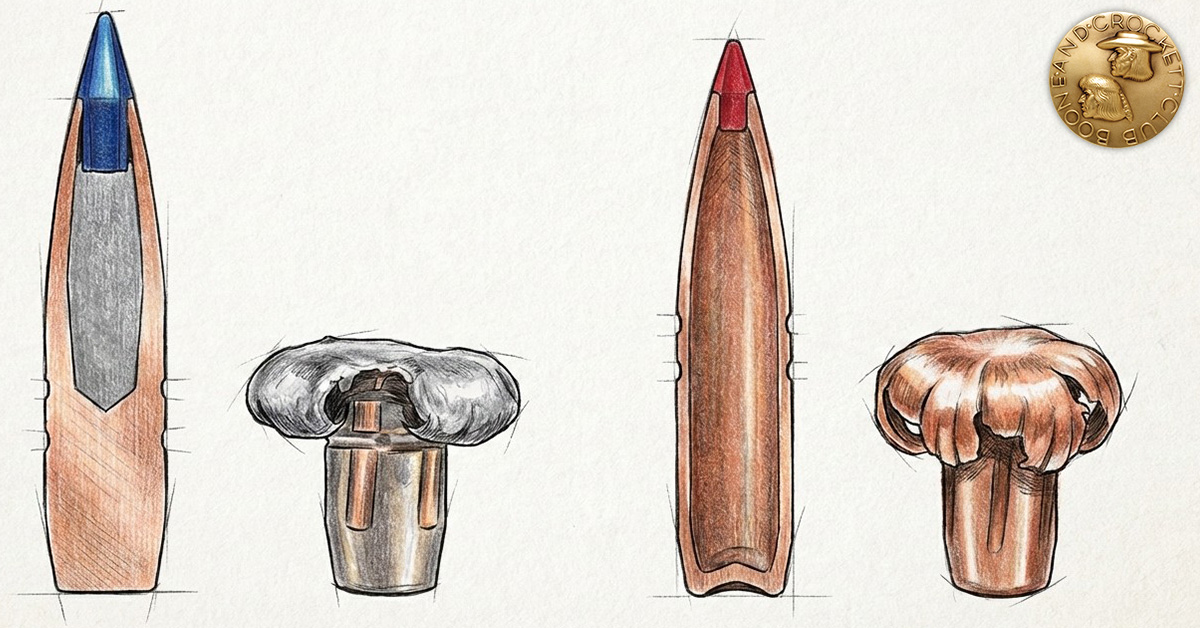
Why bullet design matters almost as much as practice and proficiency
By Chad Carman
Discussions around bullet selection rival debates over net versus gross and even caliber choice itself. Any online forum, Facebook group, or campfire conversation will offer endless testimonials of animals killed at extreme distances, steep angles, or with equipment that appears mismatched to the task. Those stories are real, and they matter. As a good friend of mine puts it, not many animals survive a bullet placed in the right spot. A well-placed shot through the heart and lungs will kill, regardless of construction. That truth has not changed.
Make no mistake, shot placement remains king. However, bullet construction determines what happens when things don’t go as planned.
Despite the ever-increasing number of hybrid bullet designs on the market, nearly all modern big-game hunting bullets fall into three foundational categories: cup-and-core, bonded, and monolithic copper. You will find combinations that blur those lines, especially as manufacturers apply polymer tips to nearly every option. Even so, understanding the underlying architecture remains critical to making ethical shot decisions in the field, based on conditions, distance, and the animal pursued.
The best bullet is not the most expensive option on the shelf or the one with the highest advertised capability. It is the bullet a hunter is willing to practice with, understands intimately, and can place with confidence when conditions are imperfect
Cup and Core
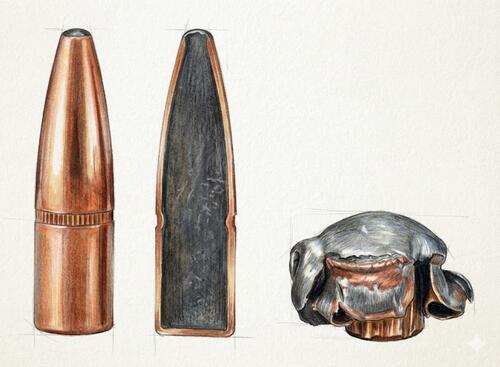
Cup-and-core bullets consist of a lead core seated inside a copper alloy jacket that is mechanically joined but not bonded. This is the most traditional and widely used hunting bullet design in North America, and for good reason. Lead is an ideal material for controlled expansion. In cup-and-core designs, thinner jackets allow the bullet to upset rapidly upon impact, creating large wound cavities and efficient energy transfer. These bullets are typically accurate, affordable, and highly effective at common whitetail distances.
One could reasonably argue that more North American big game, from whitetail to elk, has been taken with the cup-and-core Remington Core-Lokt or Winchester Power-Point than perhaps any other bullet design in history. That legacy explains why these bullets continue to dominate whitetail camps across the Midwest and South. For short- to moderate-range hunting of thin-skinned game such as whitetail deer, pronghorn, and many mule deer scenarios, cup-and-core bullets are often all that is required. Inside 200 yards, especially on broadside or lightly quartering shots, they perform exactly as intended.
The limitation is not lethality, but tolerance. Because the core and jacket are not bonded, cup-and-core bullets are less forgiving at high impact velocities, steep angles, or when heavy bone is encountered. In those situations, it is certainly possible for a cup-and-core bullet to fail to achieve adequate penetration on a thick-skinned, heavy-boned animal. A poorly placed shoulder shot may do little more than damage bone and muscle, leaving an animal to limp away rather than reach the vitals. That does not make cup-and-core bullets unethical. It defines their intended operating window. Used within that window, they are efficient tools. Used outside of it, they reduce the margin of error.
Bonded Bullets
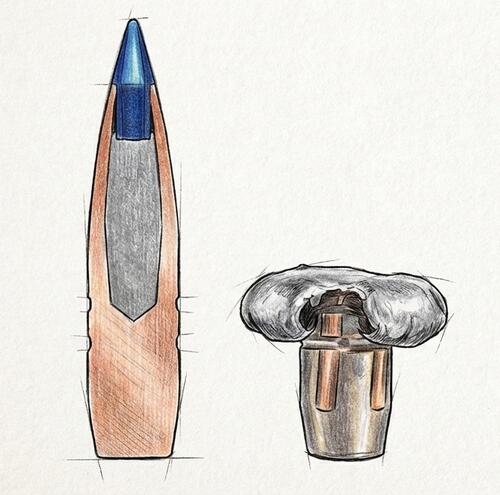
Bonded bullets exist because hunters wanted consistency across a wider range of scenarios. By chemically or mechanically bonding the lead core to the jacket, manufacturers retain a much greater percentage of the bullet’s original weight upon impact. Rather than shedding mass early, bonded bullets are designed to drive deeper into the animal while still expanding in a controlled manner. This construction allows them to perform reliably across a broader velocity range. They are less prone to fragmentation at close range, more likely to penetrate heavy bone, and more consistent on quartering shots.
The added toughness of bonded bullets introduces trade-offs, though. At very short ranges, particularly when impact velocity is high and shot placement avoids heavy bone, some bonded designs may pass completely through an animal with relatively limited energy transfer. In these cases, the bullet performs exactly as designed, retaining weight and penetrating deeply, but the result may be less immediate visual reaction or perceived “knockdown” than hunters expect. After all, physics is physics. This does not indicate failure. It reinforces that bonded bullets prioritize penetration and consistency over rapid energy dump, especially at close range.
This balance is why bonded bullets like Federal’s Terminal Ascent line have become staples for western big-game hunters. Elk, moose, and large-bodied mule deer inhabit terrain where shot distance, angle, and presentation are unpredictable. A bonded bullet offers insurance against those unknowns and maintains consistent terminal performance across a wide range of impact conditions.
For hunters pursuing big-bodied, mature moose in the Yukon or Alaska, especially where longer shots are possible and recovery is critical, bonded bullets are often the choice that balances penetration, expansion, and consistency. In these environments, hunters tend to favor bullets that perform predictably across a wide range of distances and angles rather than those optimized for a narrow set of conditions. Bonded designs are not the only viable option, but their versatility explains why they are commonly selected for these hunts.
Monolithic/Copper
Monolithic bullets are constructed from a single piece of copper or copper alloy and are designed to expand by peeling back engineered petals while retaining nearly all their original mass. This construction results in exceptional straight-line penetration and consistent performance through heavy tissue and bone. Unlike lead-core bullets, monolithic designs rely on structural integrity rather than mass loss to reach vital organs, making them among the toughest hunting bullets available. Importantly, these bullets were also born out of a desire among ecologically conscious hunters to limit lead dispersion in the field, particularly in areas where scavenging wildlife may be exposed to bullet fragments.
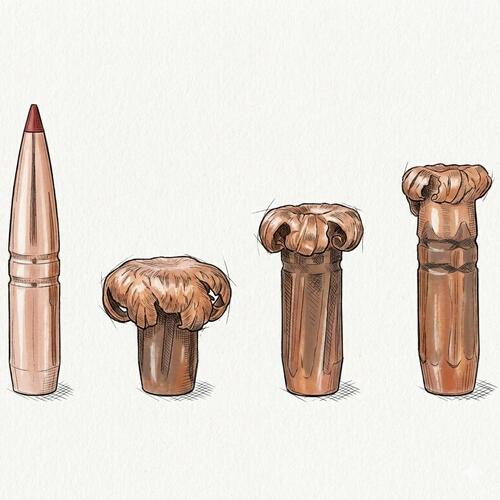
There are several reasons hunters choose monolithic bullets today. The first is legal. In California, lead-free ammunition is required by law, making copper bullets the only option. The second is personal ethics. Many hunters voluntarily choose monolithic designs to minimize environmental lead deposition, particularly in sensitive ecosystems or areas heavily used by scavenging species. A third motivation is performance preference. Some hunters value the inherent strength of copper bullets and intentionally select them for their ability to penetrate deeply and create both entrance and exit wounds, even on large, heavy-boned animals. Bullet lines such as Winchester's Copper Impact and Fiocchi’s Backwoods Hunter reflect this philosophy, prioritizing structural integrity and straight-line penetration.
Cost, however, is often part of the equation. Copper bullets are typically more expensive to manufacture, which can limit how often hunters are willing or able to practice with them. That reality has historically pushed monolithic ammunition into a premium category. Newer offerings like Fiochhi’s Backwoods Hunter are priced only slightly above traditional cup-and-core bullets, allowing hunters to adopt true copper hunting bullets without the financial barrier associated with many traditional options.
The strength of monolithic bullets also introduces important tradeoffs. Because copper is less dense than lead, these bullets are often longer for a given weight and can be more sensitive to rifle twist rate, seating depth, and overall tuning. Expansion is also more dependent on impact velocity. At extended distances where velocity drops below a bullet’s designed threshold, copper bullets may fail to open fully, resulting in narrower wound channels. While penetration is rarely a concern, hunters must understand and respect these velocity windows to ensure reliable terminal performance.
Ethics Afield
Bullet nuances like polymer tips and boattail bases influence how bullets fly and how they initiate expansion, but they do not change a bullet’s fundamental construction. A tipped cup-and-core bullet remains a cup-and-core bullet. A boattail bonded bullet remains bonded. Tips can improve ballistic efficiency and help initiate expansion at lower velocities, while boattails reduce drag and wind drift at longer distances. Neither feature replaces appropriate bullet construction for the game being pursued. Inside typical hunting distances, especially under 250 yards, these design elements often matter far less than hunters assume.
I won’t ignore the stories of small-caliber rifles taking large game with match-style bullets that circulate widely online, particularly in long forum threads and social media groups. These accounts are often cited as evidence that traditional assumptions about bullet construction are outdated. On the contrary, they prove something far more important. They demonstrate that disciplined shot placement, a clear understanding of personal and environmental limitations, and ethical restraint matter more than ever. These stories are not an argument against bullet construction. They are evidence that overlap has increased, not that margins of error have disappeared.
Ultimately, ethical outcomes in hunting are shaped more by preparation and proficiency than by bullet selection. Premium bullet designs offer real advantages, but only when paired with a hunter capable of placing them precisely in the field. If cost is a limiting factor, the ethical choice may be to select a proven, affordable bullet and invest the difference in practice. More time behind the rifle builds familiarity with recoil, reinforces judgment, and sharpens shot placement far more effectively than chasing incremental gains in bullet performance. The best bullet is not the most expensive option on the shelf or the one with the highest advertised capability. It is the bullet a hunter is willing to practice with, understands intimately, and can place with confidence when conditions are imperfect. Bullet construction provides margin for error. Proficiency determines whether that margin is ever needed.