

B&C Fellow - Andi Stewart
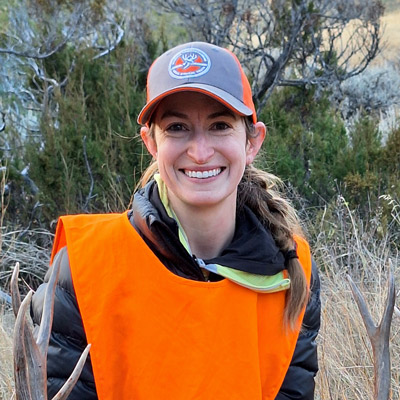
University of Montana - Ph.D. in Wildlife Biology - Projected to Graduate Spring 2027
Project Title: Factors affecting elk population dynamics in Northwest Montana
Andi earned her undergraduate degrees in Fisheries and Wildlife Sciences and Environmental Science at Oregon State University. After graduating, she moved to the Sierra Nevada Mountains where she worked for several years on different projects studying black bears, bobcats, bats, bighorn sheep, mountain lions, and mule deer. In 2022, she completed a master’s degree in wildlife biology at Utah State University, studying mule deer populations in partnership with the California Department of Fish and Wildlife. For her doctoral research, Andi is collaborating with Montana Fish, Wildlife & Parks on the Integrated Elk, Habitat, and Carnivore Management Project in northwest Montana. Her work focuses on estimating elk population vital rates in Hunting District 121, including adult survival, calf survival, and pregnancy rates, and evaluating how these parameters affect population growth.
Factors affecting elk population dynamics in Northwest Montana
Andi’s research focuses on evaluating population dynamics of the Hunting District (HD) 121 elk herd in northwest Montana. The goals are to estimate juvenile survival, adult survival, and fecundity, and to evaluate their relative influence on population growth. The first objective is to estimate juvenile survival and assess factors influencing it, including predation, calf biological traits, and maternal age. The second objective uses GPS-collared adult females from 20 populations across Montana to examine how individual variation in habitat selection affects adult female survival. The third objective is to develop an integrated population model using estimates of vital rates and abundance to determine which parameter is driving population growth. Simulations will then forecast the effects of different management outcomes on the HD 121 elk population. The resulting analytical tool will support science-based, targeted management strategies for achieving HD 121 elk population objectives.