

B&C Fellow - Chloe Nouzille
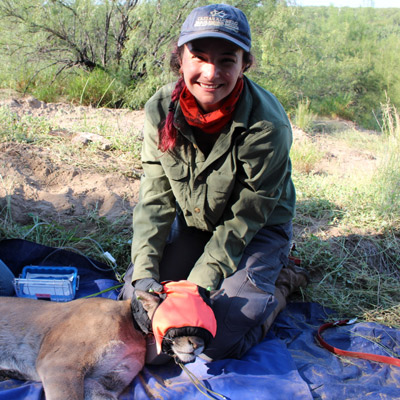
Caesar Kleberg Wildlife Research Institute - Texas A&M University Kingsville - Ph.D. Student in Wildlife & Rangeland Sciences - Projected to Graduate December 2027
Project Title: Investigating the distribution and behavioral ecology of mountain lions in South Texas
I grew up in California and received my B.S. in Ecology and Evolutionary Biology from the University of California – Irvine. As an undergraduate, I worked as a veterinary technician and a laboratory assistant, but there were few research opportunities to participate in nature. After my third year, I was privileged to work as a research assistant at Mabula Game Reserve in South Africa, where I studied the behavior of elephants, rhinos, and lions. This pivotal moment solidified my desire to work with wildlife. Following graduation, I interned with the National Park Service, studying mountain lions in a fragmented landscape, and gained valuable field skills. My M.S. at the University of California – Los Angeles focused on mammal recovery and recolonization following one of California’s megafires. As a Ph.D. student, I study mountain lion ecology in South Texas through the Caesar Kleberg Wildlife Research Institute at Texas A&M University – Kingsville.
Investigating the distribution and behavioral ecology of mountain lions in South Texas
Structural barriers are thought to affect wildlife worldwide, yet few studies have quantified their effects on population viability. Such research is particularly pressing considering the construction of border barrier-system separating the United States and México. We are working with state, federal, and private partners, to study mountain lions (Puma concolor) in southern Texas as one of the first evaluations of the potential impacts of the border barrier-system on large carnivores. We will assess effects of the border barrier-system on transboundary movements, genetic connectivity, and population dynamics of mountain lions and identify strategies to mitigate adverse effects on mountain lion population viability in Texas. Our work will address an important and common problem of the fragmentation of large carnivore populations by human structures and will provide a case study for the partnerships required to confront this emerging issue.