

B&C Fellow - Jenna Krugler
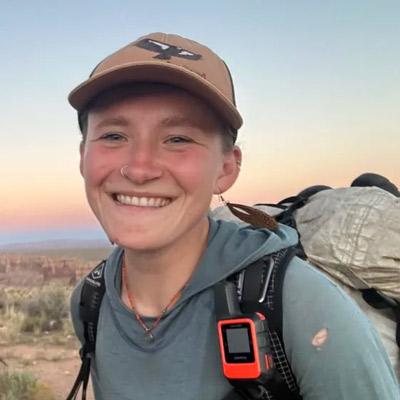
Clemson University Forestry and Environmental Conservation - Ph.D. Student in Wildlife and Fisheries Biology - Projected to Graduate 2028
Project Title: Beavers, birds, and big game: restoration and conflict management across diverse landscapes
My upbringing in the mountains of Northern California and a lifelong love of animals and the outdoors lead me to pursue a career in wildlife biology and conservation. Since graduating with a bachelors in environmental science I have worked on a wide variety of projects ranging from bighorn sheep respiratory disease ethology in Montana to California condor reintroduction in Utah and Arizona.
My experiences with conservation across the western United States only served to deepen my appreciation for species conservation and the on-the-ground problem solving it requires. By pursuing a Ph.D. I hope to expand my skill set so that I can bring science driven and informed decision making to my future conservation work.
Beavers, birds, and big game: restoration and conflict management across diverse landscapes
My research aims to improve restoration and management outcomes for beavers and elk in the southeastern United States, and to better understand the impacts of beavers and low-tech process-based restoration tools on stream restoration in the Northern Great Plains of eastern Montana. The beaver research in South Carolina will assess the efficacy and comparative costs of using “flow devices” for nonlethal beaver management, specifically culvert fencing and pond levelers. In conjunction with the Wildlands Network, we also aim to develop a landscape-scale socio-ecological suitability and connectivity model for elk in the southeastern U.S. based on current and future land use conditions. In eastern Montana we are partnering with the Smithsonian Institute to study the impacts of Beaver Dam Analogues (BDAs) on microclimate and avian activity, with real beaver dams as a basis of comparison. This research will help us understand how beavers and restoration impact both vegetation and wildlife communities.