
B&C Fellow - Percy Marshall
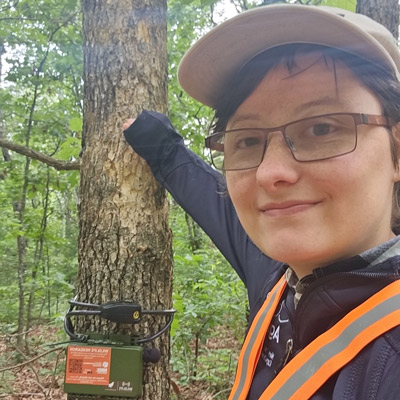
Clemson University - Ph.D. Student in Wildlife and Fisheries Biology - Projected to Graduate 2027
Project Title: Effects of Habitat Restoration Efforts on Early Secessional Bird Species Populations and Future Predictions
I am a driven conservationist with a passion for community outreach and extension. I grew up enjoying the beauty and majesty of the Great Lakes in Michigan. My undergrad research focused on the changing landscapes of the NY forests. I then worked for Cornell AgriTech IPM for invasive plant and insect populations effects on croplands. For my masters, I narrowed in on waterbirds and their effects on ecosystems and humans. I am happy to now focus my efforts into gamebirds in my continued vision of helping preserve natural spaces and recreations for generations to come.
Effects of Habitat Restoration Efforts on Early Secessional Bird Species Populations and Future Predictions
My research pertains to the restoration of grassland bird habitat and using acoustic monitoring to measure its success. For the course of my PhD, I will have my Song Mini Meter 2.0s deployed in Mississippi, Missouri, Ohio, and Georgia at the density of 200 per county (as determined by a power analysis). I will also maximize the number of point counts taken at each deployment point (2/ ARU). With these data I aim to research the following:
- What is the occupancy/abundance of the target grassland bird species in each of the target species? And how does it change with different management schedules?
- How effective are less resource-intensive monitoring efforts (e.g citizen science data sets) from more intensive ARU and point count data sets? Are there intermediate setups that allow monitoring programs to ramp up their efforts (e.g 100 ARUs per county, ARU movement between monitoring points, shorter monitoring daily windows) This will use integrated models such as those posed by Doser et al and Martin et al in comparison to more individual data source models.
- What futures do these study locations (and other similar lands) hold under different management actions/inactions?