
B&C Member Spotlight—John M. Olin
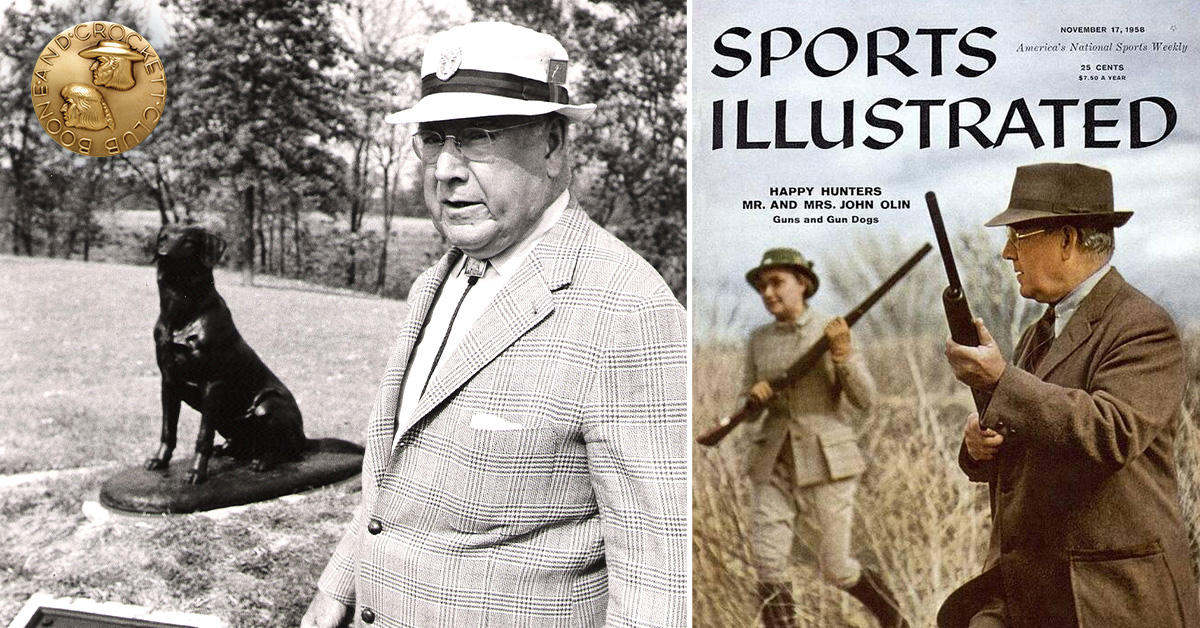
John Olin was a business titan who understood that if there was no game left to hunt, consumers would have little use for his company’s Winchester firearms, or Western ammunition. He stood at the crossroads of industry and science, using the weight of the Olin Corporation to help fund the future of conservation.
By Steve Wagner
Since its inception, the Boone and Crockett Club has been a bridge between science, conservation, and hunting. After all, without science-based conservation, there would be no hunters—and thus no hunting industry.
In 1887, Theodore Roosevelt’s original cast of Club members included George Bird Grinnell, owner and editor of Forest and Stream, essentially the Wall Street Journal for that era’s sportsmen. Others ran companies deeply vested in the commercial success of hunting, such as leather-goods magnate Bronson Rumsey, and Archibald Rogers, whose freight services buoyed manufacturing supply chains and retail product distribution. Today, the corporate connection continues with Johnny Morris of Bass Pro Shops/Cabela’s, past-Club president Tony Caligiuri of Boyt Harness Co., and CJ Buck of Buck Knives, just to name a few.
Nestled between the Club’s early pioneers and its modern-day CEOs, there was John Olin.
Reviving Winchester
Born in 1892, Olin began his career in 1913 as a 21-year-old chemical engineer for his father’s Western Cartridge Co. A series of mergers and acquisitions found the youthful Olin moving up into various executive positions. In 1957, he was named chairman of the board of the conglomerate Olin Corp., which by then was involved in a dizzying array of consumer and industrial products. The company continued to make ammunition while expanding into chemicals, explosives, fuels, pharmaceuticals, lumber, metals, and even sporting goods like downhill skis.
Olin was an inventor and a sportsman at heart, holding 24 patents in firearm and ammunition design. He took the helm of Winchester Repeating Arms in 1931 when Western Cartridge Co. pulled the brand out of bankruptcy. Some historians believe that if it weren’t for the Olin family, the company best known for making “The Gun That Won the West” might have disappeared for good. Olin rescued and ran Winchester until he stepped down as chairman of Olin Corp. in 1963.
Success in game restoration means continuance of the industry; failure in game restoration means its shrinkage and ultimate liquidation.
—Aldo Leopold, “Game Survey of the North Central States”
Olin was a staunch protector of Winchester quality, accepting thin margins on rifles because they served as grand advertisements for his highly lucrative cartridge business. But Olin’s departure gave junior managers their long-awaited chance to apply spreadsheet logic for better profits. In 1964, they launched an infamously retooled Model 70. They abandoned the legendary controlled-round feed (which used a claw extractor for reliable cycling) in favor of a cheaper push-feed system. They swapped elegant, cut-checkering on the walnut stocks for low-budget pressed patterns, and replaced machined steel trigger guards with flimsier alloys. Big game hunters howled in disapproval. The resulting public relations backlash turned Olin-era “pre-64s” into high-demand collector’s items even to this day.
Funding the Science: The Leopold Connection
Growing up in the early 1900s with the Western Cartridge Co. in East Alton, Illinois, Olin learned to hunt when nearby river bottoms teemed with ducks, and quail flourished on the region’s small farms. In the 1920s, he was alarmed at the decline of gamebird populations, followed by the poor land conservation practices that led to the catastrophic dust storms of the early 1930s.
In 1928, as a Western executive, Olin was elected chairman of a special committee of the Sporting Arms and Ammunition Manufacturers’ Institute (SAAMI), a consortium of leading firearms and ammunition companies. He immediately convinced his “Committee on Restoration and Protection of Game” to hire a young scientist named Aldo Leopold.
Leopold’s work focused on first-of-its-kind research on wildlife in a specific region. The purpose was to appraise game and habitat management as a means of restoring depleted populations of upland birds and waterfowl. This was a revolutionary concept. At the time, propagating and releasing pen-reared gamebirds was standard practice, without much thought given to the land or its various conditions and uses.
According to Senator Harry B. Hawes, author of the Duck Stamp Act of 1934 and a close friend and hunting companion of Olin, this shifted Leopold from a forestry-focused career to wildlife management, where he would become a legendary figure and a Boone and Crockett Club professional member.
Leopold’s groundbreaking 1931 report back to Olin and the SAAMI committee, titled “Game Survey of the North Central States,” included a preface that didn’t mince words. “The survey was financed by the sporting arms and ammunition industry. The motive hardly requires explanation. Success in game restoration means continuance of the industry; failure in game restoration means its shrinkage and ultimate liquidation.” Subsequent landmark works by Leopold specifically acknowledged Olin for his role in rallying continued support from the hunting industry.
Under Olin’s leadership, SAAMI dedicated itself to backing several early conservation groups that, over time, evolved into the organizations we know today: Ducks Unlimited, North American Gamebird Association, and Wildlife Management Institute. SAAMI also sent major hunting industry contributions to the Game Conservation Institute, or Clinton Game School for short, which operated in New Jersey from 1931 to 1934. Curricula were heavily influenced by Leopold, and it graduated some of the first technically trained employees of state game and fish departments, which had previously been staffed mostly by political appointees. The school closed when major universities followed its example and began offering formal degrees to train professionals in the fast-growing field of wildlife management. Certainly, Olin’s fingerprints were all over this important academic and cultural shift to shape the future of conservation.
Voluntary Taxation
In 1918, Congress imposed a 10 percent federal excise tax on firearms and ammunition to fund a new migratory game bird law, but the money instead went to the government’s general fund to help finance World War I costs. The tax expired in 1928, then restored in 1932, but again the money was diverted to the general fund during the depths of the Great Depression. The tax was scheduled to sunset again in 1938—but a critical pivot arrived early.
In 1937, Congress passed the Pittman-Robertson Federal Aid in Wildlife Restoration Act. This legislation diverted the hunting industry’s excise taxes from the federal government’s general fund to a separate account for wildlife management initiatives, and extended the tax indefinitely. Olin voiced his full support for this new program from his seat on the SAAMI committee and from his desks at Western and Winchester.
During World War II, all federal excise taxes were increased from 10 to 11 percent to help fund the war. That increase was rescinded after the war, yet Olin convinced SAAMI to specifically request that the full 11 percent tax on guns and ammo be retained. No one wanted to see Pittman-Robertson funding headed the wrong way. Voluntary taxation was unheard of, but the hunting industry believed professional game management was worth the investment.
That self-taxation became yet another move of destiny. After the war, America entered a period of great economic prosperity, along with many new hunting products to spend the money on. Pittman-Robertson funds began to grow even more rapidly.
A Conservation Legacy
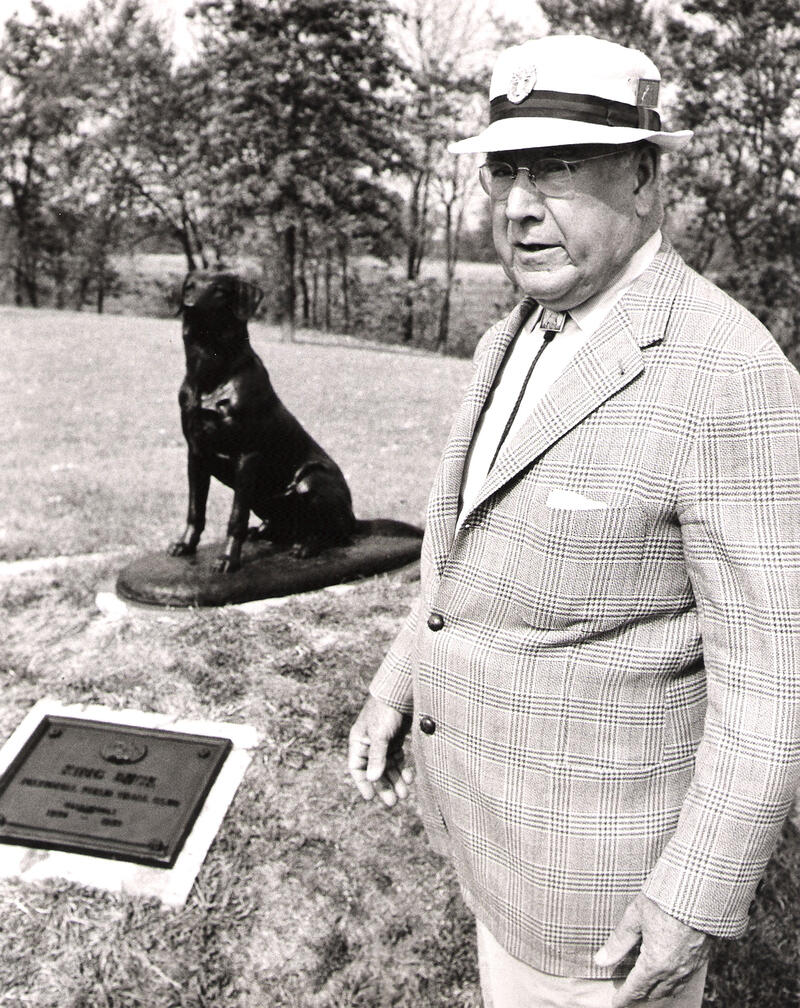
All along the way, Olin was tinkering with his own conservation and hunting enterprises. In 1935, he formed the Western-Winchester Game Restoration Department, a small demonstration farm in East Alton, which focused on habitat improvements and quail stocking. In 1952, he launched the Winchester Conservation Department to promote professional game management and put-and-take gamebird hunting preserves, with the storied Nilo Farms as its centerpiece. Nilo (Olin spelled backwards) was a living laboratory for gamebird propagation, habitat management, scientific research, clay target sports, Labrador retriever breeding and development of dog training techniques. It also, of course, was a private hunting retreat for Olin and his business associates, political allies, and conservation-minded dignitaries.
In the 1970s, Nilo Farms was the site of a steel-shot lethality study that was instrumental in federal regulations changes that ended the use of lead shot in waterfowl hunting.
Olin was elected to membership in the Boone and Crockett Club in 1961. He served until his passing in 1982. During his tenure, Olin reinforced the Club’s continuing support of science-based wildlife management. He helped to promote ethical hunting and big game records programs, provided invaluable guidance on advocacy and education, initiatives and policies—all from the perspective of a hunting industry leader. And he continued his long legacy of philanthropy to causes that he believed in.
The conservation funding mechanisms that Olin championed not only paid for the game populations required to keep Winchester, Western, and other firearms and ammunition companies afloat, but still serve as a vital foundation of the sporting way of life that so many Americans still cherish today.
Member Spotlights
Boone and Crockett Club members have come from a cross-section of famous accomplished people whose lives and careers have written and recorded the history of this country since the late 19th Century. They have been naturalists, scientists, explorers and sportsmen, writers and academicians, artists, statesmen and politicians, generals, bankers, financiers, philanthropists, and industrialists. Their diversity of ideas and activities during their careers have made the Boone and Crockett Club rich in its fellowship and achievements. To read more member spotlights, just click here.