

B&C Member Spotlight — Valerius Geist
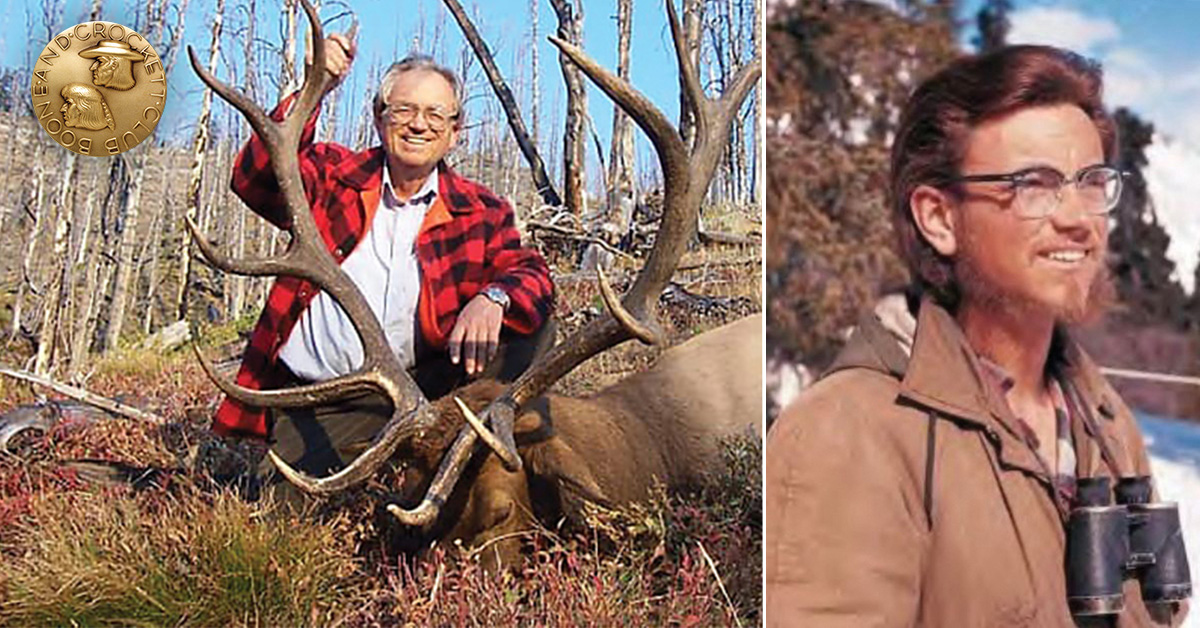
When Valerius Geist walked into a room, it didn't take long before everyone gravitated toward him. Regardless of the topic, his infectious enthusiasm drew colleagues and students into conversations that ranged from wine-making to game farms to predator control.
By PJ DelHomme
Geist became a Professional Member of the Boone and Crockett Club in 1996, and his legacy as a pioneering wildlife biologist, author, and architect of conservation philosophy touches just about every facet of North American wildlife management today.
Shane Mahoney is an internationally recognized conservationist who studied under Geist, both as a student and a colleague. He was also a close friend. For months at a time, Mahoney would visit with Geist and his wife, Renate, staying in a guest cottage on a plot of land in Port Alberni on Vancouver Island. A typical day at the Geist house would start with breakfast, followed by Val leaving to feed his assortment of ducks, geese, goats, and other barnyard creatures. "He often dressed in a polo and khakis, but within half an hour he'd come back in the house and be covered in shit and hay," Mahoney recalls. "Mrs. Geist would chide him about wearing his nice clothes to work with the animals."
Then Val might look out the window, and something would spark a conversation about the Migratory Bird Treaty, which would lead to a hunting story, which would turn into a larger extrapolation about how hunting and preserving these animals would, in turn, lead to a discussion about early hunter-gatherers.
"And then every evening was a visit to a theater, not that anyone was performing. But all the things we go to a theater for—drama, comedy, intrigue, understanding of humanity," Mahoney says. "Every single supper was an exercise in this. The topics ranged from a recent paper we both read to perhaps a book Mrs. Geist was reading. The food would be sumptuous, healthy, and organic in the truest sense of the word. It would be their rabbits, a goose maybe. And dairy from the farm next door. The desserts were made from fruits from his trees. I looked forward to those dinners, which lasted two or three hours every evening.
"Val was the boisterous one at the table and eating like a shark. He was like a vacuum cleaner," Mahoney adds. "Mrs. Geist would admonish him and pick at her dinner. Keep in mind, I always say the Geists because it wasn't just him. He wouldn't be the person he was without her. There were so many strong, intelligent women who were the center of his formative years."
From War-Displaced Immigrant to World-Renowned Scholar
Those formative years began in Mykolaiv, then part of the USSR, where he was born Valery Shutov in 1938, amid the turmoil of World War II, which shaped much of his early life. Geist's father died in combat, and he and his mother fled first to Austria and then Germany before emigrating to Canada at age 15 in 1953. Along the way, they exchanged their family name, Shutov, for Geist—a tribute to his mother's lineage.
Because Geist's father and grandfather died in Russia, he was raised "very much in the company of women," Mahoney says. "This had a great influence on him in the sense that his relationships were very respectful and warm." Canadians, too, welcomed Geist into their lives. When he came to Canada as a boy, he was very interested in hunting. He would remark how the Canadian people in the communities where he lived—men in particular—welcomed him and taught him about hunting. "He would always remark how kind those people were to him, and this had a subliminal importance in my view," Mahoney says. "He didn't really have a father figure in his life, and these local farmers loved to hunt and fish. I think this was a very important part of his attachment to Canada."
Settling in British Columbia, Geist earned his B.Sc. and Ph.D. in zoology at the University of British Columbia. His doctoral thesis—on the behavior and evolution of American mountain sheep—became a benchmark for future research. Under the mentorship of ecologist Ian McTaggart-Cowan, Geist's work shed light on evolutionary processes before terms like "punctuated equilibrium" entered scientific jargon.
His 1978 book, "Life Strategies, Human Evolution, and Environmental Design—Towards a Biological Theory of Health," was his most impressive, says John Organ, Boone and Crockett Club Professional Member, colleague, and close friend to Geist. Decades ahead of its time, the book was a synthesis of evolutionary science and the imperative of environmental health. It was a tutorial for integrating animal behavior, evolution, and the idea of nature's role in human well-being.
After postdoctoral study with Nobel Laureate Konrad Lorenz, Geist founded an interdisciplinary program in Environmental Design at the University of Calgary. He led this program until 1995, and it became a model for academic innovation. Asking questions was always part of Geist's thought process. "One of the characteristics I admired most was that he was never afraid to say that he didn't know something," Organ says. "That was a big part of his brilliance. His mind was so open. He could see things others couldn't."
Geist's brilliance didn't go to his head or get in the way of his welcoming nature. "The last time I saw him in person, it was at a Boone and Crockett Club annual meeting in Tucson," Organ recalls. "Geist was standing there with his back against the counter with a semicircle of people around him. I stood there behind them, and once he saw me, he took my hand in both of his, and he treated me like a son. It's one of my fondest memories. We would sit outside on a bench and just talk. I'm really grateful to Shane for introducing me."
The North American Model and Beyond
Among Geist's most enduring contributions is his articulation of the North American Model of Wildlife Conservation. He was the first to clearly define its key principles—among them public ownership of wildlife, science-driven policy, and allocation by law. Geist had intimate experience with both European and North American hunting culture. "He proudly wore his Jaeger coat to scientific meetings, earned under the strict and challenging hunting protocols and training in Germany," wrote Organ and Mahoney in a tribute after Geist passed away in 2021. His scholarship and advocacy helped distinguish North America's wildlife governance from European systems and guided a generation of scientists.
Geist cautioned against the commercialization of wild game, especially game farms and ranches, warning of their ecological risks and the potential for new diseases such as chronic wasting disease. His outspoken criticism earned both admirers and detractors. "They were calling him 'Delirious' Geist, putting him down because of his stance on everything from game farms to predators," Organ says.
Like many hunters, Geist had an opinion on wolves. "We talked a lot about this," Organ says. "He believed that wolves and people do not coexist well. He thought the best way to keep large carnivores on the landscape was to keep a large contingent of inefficient hunters on the landscape. Those hunters don't eliminate all of the predators; they essentially just keep them from habituating to humans. The very act of being pursued by hunters would lead large carnivores to avoid humans, thereby reducing conflicts."
Over the course of his career, Geist authored 19 books (with two unfinished at the time of his death), hundreds of scientific papers, and technical policy reports that shaped conservation law and practice from the 1970s through the early 2000s. His involvement with the Boone and Crockett Club—as the only North American hunter to attain professional membership in both Boone and Crockett and the European International Council for Game and Wildlife Conservation—underscored his international reputation.
A Generous Spirit and Mind
To those who spent time with Geist, he was the very model of the Renaissance man. In his leisure time, he cooked, made wine, and played classical guitar, hoping to keep his mind active to stave off dementia in his later years. His conversations spanned hunting and animal behavior to philosophy, art, ballistics, and human evolution. His intellect could turn a simple question into a journey, with answers delightfully circuitous and richly detailed. "You could ask him, 'What's two plus two,' and it would take him 20 minutes to answer. He was so animated," says Kevin Hurley, Vice-president of Conservation Emeritus at the Wild Sheep Foundation and also a Boone and Crockett Club Professional Member. "He was so energetic and full of life. He faced a lot of hard things in his life, but what an eternal optimist…I doubt the Energizer Bunny could have kept up with Val," Hurley added.
When Hurley worked at Wyoming Game and Fish (WGFD) as the statewide bighorn sheep coordinator, bighorn sheep managers with WGFD reached out to Geist for advice on how to re-establish altitudinal seasonal movement by bighorn sheep in the Teton Range. The problem was that bighorn sheep in the Teton Range were no longer migrating to lower-elevation winter ranges. Staying in the Teton high country exposed bighorns to incredibly harsh winter conditions, and WGFD was wondering how it might be possible to re-initiate a long-lost altitudinal seasonal movement, following the vacancy of six domestic sheep grazing allotments on the west slope of the Tetons. Geist accepted an invitation to visit Wyoming and its bighorn sheep herds, touring several herd ranges. "We turned to him because he was such a thinker and behaviorist. And he came up with a typical 'Valism,'" Hurley recalls. "Val suggested trying a reverse 'Pied Piper' approach. He said what you guys need to do is train some lambs to follow you elevationally with a salt block, basically eating out of your hand. He wanted us to show those bighorn sheep that there was still forage and safety down low. That was the kind of brain and thought process that Val had."
Enduring Optimism and Legacy
Even in his final weeks, Geist's optimism and love of life shone through. Renate had passed in 2014, and Geist was dealing with diabetes and circulation problems. That may have slowed him, but his brain was still firing on all cylinders. "Two weeks before he died, we were exchanging emails about his health, which in vintage Geist style, morphed into legal issues about trapping, and a recent paper he authored on predator pits," Organ recalls. "His last words to me were, 'Right now I am simply hoping that I can go hunting again. Time will tell.'"
And how he loved email. "Geist would check his email in the morning, and he would announce joyously that he had 323 emails. He would be absolutely delighted to have this deluge of requests," Mahoney says. "And he never lost that. I can still see him coming out in his bathrobe and announcing it. He took absolute joy in it."
At the very end, Geist elected to undergo a risky surgery that would have allowed him to return to his farm, feed the animals, and get covered in hay and earth once again. "He would say, 'Shane, I had a great life.' He and his wife always said that. He knew that he had a great life based on what he had seen. If he couldn't have gone back to that life with his animals and gardens, then you know, there was really no point." He died of heart failure on July 6, 2021.
"The wild sheep community, the wildlife profession, and so many others benefitted from Val Geist's time on Earth," Hurley adds. "He was a unique and marvelous man."
"I have had two profound blessings in my life," Mahoney says. "One, that I was born in and grew up in Newfoundland. And the second is to have had the time with Val and Renate Geist."
Member Spotlights
Boone and Crockett Club members have come from a cross-section of famous accomplished people whose lives and careers have written and recorded the history of this country since the late 19th Century. They have been naturalists, scientists, explorers and sportsmen, writers and academicians, artists, statesmen and politicians, generals, bankers, financiers, philanthropists, and industrialists. Their diversity of ideas and activities during their careers have made the Boone and Crockett Club rich in its fellowship and achievements. To read more member spotlights, just click here.