

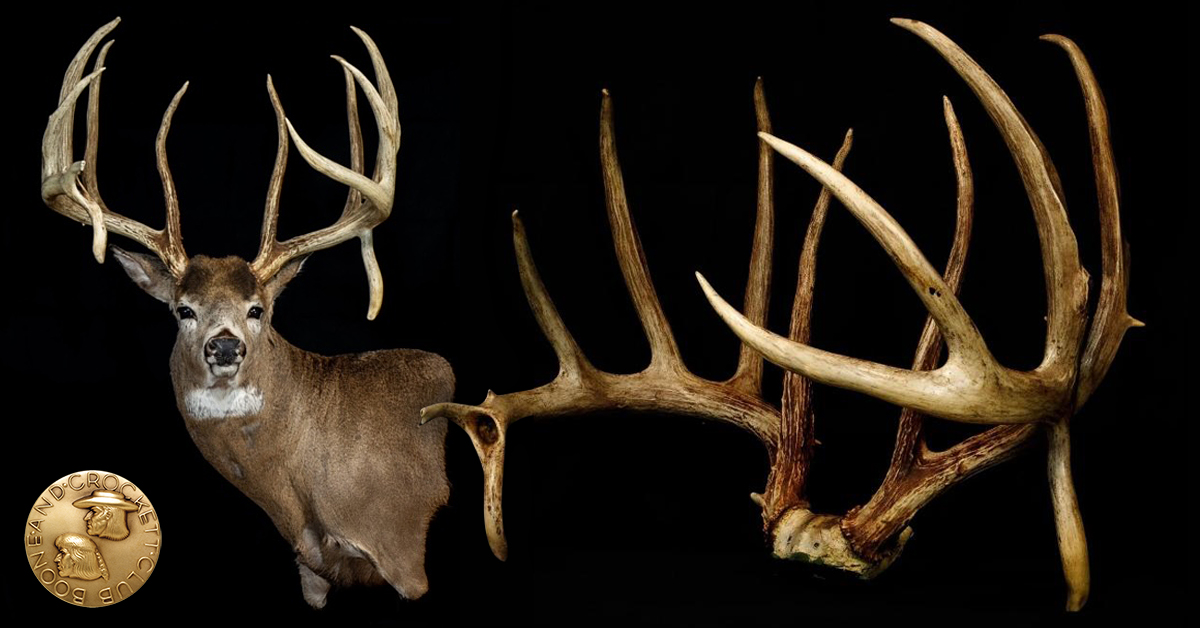
MISSOULA, Mont.—(September 8, 2026) The Boone and Crockett Club announced today that the Sam Aiuppa/James Martin typical whitetail deer has officially been verified at a score of 207 7/8 inches, making it the largest typical whitetail ever taken in the United States.
The score surpasses the famous Jordan buck by 1 6/8 inches and ranks second worldwide behind Milo Hanson’s 213 5/8-inch world record.
Sam Aiuppa killed the buck in late November 1991 during a pheasant hunting trip to LaSalle County, Illinois. He mounted the antlers on a plaque and stored them in his basement, where they remained for 32 years until an electrician noticed their extraordinary dimensions, most notably eye-guards more than a foot long.
Antler collector James Martin later acquired the antlers and had them measured by a Boone and Crockett Club Official Measurer. After the initial score was submitted, the antlers were independently re-measured by two additional Official Measurers to verify the score. The completed score charts were reviewed by Dr. Jon McRoberts, chairman of the Club’s Records of North American Big Game Committee, who confirmed the official score of 207 7/8 inches.
“This is a monumental addition to North American big game records,” said Kyle Lehr, Boone and Crockett Club director of Big Game Records. “We are thrilled to officially welcome the Aiuppa buck into the Boone and Crockett records. It took more than three decades for this remarkable deer to be recognized, but its place in the record books is well deserved.”
Thanks to a generous donation from a long-time Boone and Crockett Club Lifetime Associate and conservation benefactor, the Club waived its $40 entry fee starting January 1, 2026. This gift removes a key financial barrier to submission, encouraging broader participation and expanding records data to support the science-based management of North American wildlife.
For more details on the buck's history, read “Lost For 30 Years: The New #2 Typical Whitetail and Illinois State Record.”
The Importance of Records in Big Game Management
When you enter your trophy into the Boone and Crockett system, you aren’t just honoring the animal and its habitat. You are participating in a data collection system that started in the 1920s and was refined by Club members in 1950.
Today, there are nearly 60,000 trophy records. By establishing a records database more than 70 years ago, the Boone and Crockett Club established a scientific baseline from which researchers can use to study wildlife management. If you’re still on the fence about entering your trophy, we encourage you to read Why Should I Bother to Enter My Trophy. To the best of our ability, we ensure that the trophies entered into the records were taken in accordance with the tenets of fair chase ethics. Despite what some may think, the Boone and Crockett records are not about a name or a score in a book—because in the end, there’s so much more to the score.