

From Barbed Wire to Big Data
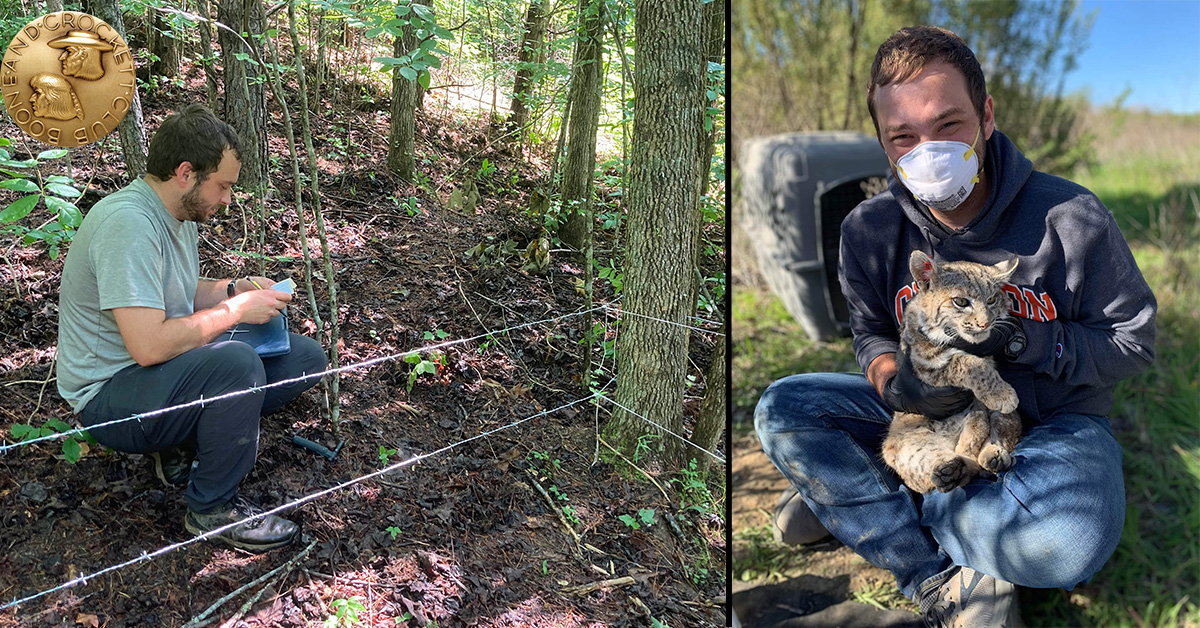
As black bear populations rebound across North America, Boone and Crockett Fellow John Nettles is pioneering high-tech monitoring methods to replace labor-intensive field traditions. By trading barbed wire for camera traps and big data, his research at Clemson University is modernizing how we manage one of our most complex apex predators.
By PJ DelHomme
For decades, the gold standard for estimating bear populations involved a lot of sweat, miles of barbed wire, and bait—typically sugary pastries or a ghastly concoction of aged fish guts and raw meat. The hair snare method relies on bears crawling through strands of wire to get to the bait, leaving tufts of hair on the bards. But it’s a logistical nightmare. Researchers string two strands of wire—one at shin height, one above the knee—around trees to create a corral. In the center goes the bait.
John Nettles, a Boone and Crockett Club Fellow pursuing his PhD in Wildlife Biology at Clemson University, knows this process intimately. In just two field seasons in South Carolina’s Blue Ridge Mountains, he and his team deploy roughly four and a half miles of barbed wire each summer. Every week for seven weeks, they visit every snare to meticulously collect hair samples with tweezers and burn off any remaining DNA with butane torches to prevent cross-contamination for the next week's check.
Genetic processing isn’t cheap, Nettles says. With over 4,300 samples collected so far (at $55 per sample test), the costs add up. The other problem is that hair snares only track the target species—in this case, black bears—while ignoring everything else wandering the woods.
The Digital Eye
This is where big data is a big help. As part of his dissertation, Nettles is comparing these traditional methods against newer, camera-based monitoring. Rather than relying on DNA from a barb, Nettles is testing "unmarked estimators" using a network of remote camera traps. Unlike tigers with unique stripes or bobcats with distinct spot patterns, black bears in the Southeast are often an indistinguishable shade of black, making it nearly impossible to tell individuals apart by sight alone.
Instead of identifying "Bear A" or "Bear B," these new mathematical models treat the camera photos as a random sample over time and space. "How many seconds across your sampling period... is there a bear at this spot?" Nettles explains. "You can extrapolate that to how many bears there are in any given second across the whole area."
The advantages of this technological shift are substantial, beginning with pure cost efficiency. Once the cameras are purchased, the primary cost is the time spent reviewing photos rather than lab fees. This is coupled with a significant gain in time efficiency, as cameras can run constantly for months without the need for weekly rebaiting and hair collection.
Perhaps most importantly, this method allows for multi-species monitoring. While a hair snare only catches a bear, a camera trap captures everything. Nettles' team has already amassed a dataset of over a million photos, enabling agencies to monitor deer, turkeys, bobcats, and other species simultaneously and providing a holistic view of the ecosystem rather than a single-species snapshot.
Redefining the Southeastern Apex Predator
The necessity for accurate data is underscored by the changing role of the black bear. In a recent literature review of over 200 scientific papers, Nettles and his colleagues investigated the ecological role of the American black bear. Their findings challenge the common perception of bears as trash-can bandits. In the southeastern U.S., where wolves and mountain lions have long been absent, black bears have stepped into the vacuum as apex predators.
In the Southeast, black bears account for nearly 30 percent of juvenile ungulate deaths, compared with just 3 percent in other regions, like the West. "We may not always view black bears in the same light as wolves, mountain lions, or grizzly bears," Nettles wrote in a recent article. "But they are dominant predators when they need to be. They can limit prey populations... and seriously injure or kill humans." A healthy bear population has a profound impact on the entire forest community, from the health of deer herds to the behavior of smaller carnivores like coyotes.
A Winding Journey
Nettles’ path to the Blue Ridge Mountains began in Austin, Texas, but his love of big skies and the wild ignited during childhood trips to Glacier National Park with his grandparents, where they spent hours searching for grizzly bears. "I think it was in eighth grade when I realized there was another option if you liked animals and science besides being a vet," he says.
Inspired by the pioneering work of the Craighead brothers, Nettles headed to the University of Montana for his undergraduate degree in wildlife biology. His career has since been a global tour of carnivore research. In China, he spent three months working on a long-term project monitoring panda behavior to see whether specific maternal care or stress-management behaviors led to better breeding success. Moving to California, he served as an assistant project coordinator for a statewide bobcat population assessment. For his senior project, he used photos from South Africa to identify individual African civets by their unique spots to estimate population density. Finally, in Alaska for his Master’s at Clemson, he shifted focus to the human side of the equation, studying bear viewing and bear safety education.
Today, his office is often a basement at Clemson University, where he’s surrounded by the digital fallout of his field seasons—over a million photos that need to be sorted, tagged, and analyzed.
Being a Boone and Crockett Fellow has provided Nettles with more than just financial support via a stipend. He credits the fellowship with providing high-level professional mentorship and connections to a community of well-known researchers. "It’s very unique for a hunting organization to have such a big role in the research," Nettles says. "It’s a great community to be a part of because the name carries a lot of weight."
For the Club, supporting researchers like Nettles is an investment in the future of conservation, including science-backed regulations. When an agency sets a harvest limit or a season date, that decision should be rooted in hard data, not guesswork.
As black bear populations continue to rebound across North America, the line between wild carnivore and human neighbor continues to blur, which brings new challenges. Increasing numbers of both people and bears have led to more frequent human-bear conflict (HBC).
"Predation plays a crucial role in maintaining a balanced ecosystem with healthy, sustainable populations of both predator and prey," Nettles says. As he continues his third year at Clemson, Nettles is helping to bridge the gap between boots-on-the-ground fieldwork and the data-driven future of conservation.
Boone and Crockett Fellows Program
Through its Fellows Program, the Boone and Crockett Wildlife Conservation Program supports graduate students in wildlife conservation and related fields. A Boone and Crockett Fellow is an undergraduate, graduate, or postdoctoral student supported by Boone and Crockett funding and/or advised by a Boone and Crockett professor or professional member. In addition to displaying academic excellence, Boone and Crockett Fellows are committed to scholarship that:
- Promotes effective conservation policy through dedication to research, education, outreach, and service.
- Exhibits leadership in wildlife conservation.
- Helps others understand the mission of the Boone and Crockett Club and the evolution of conservation in the United States.
- Recognizes and appreciates the values of hunting and fishing and the principles of Fair Chase.
For more information about Boone and Crockett Club Fellows or its University Programs, please contact Luke Coccoli, Director of Conservation Research and Education, at [email protected].