

B&C World's Record - Non-Typical Mule Deer
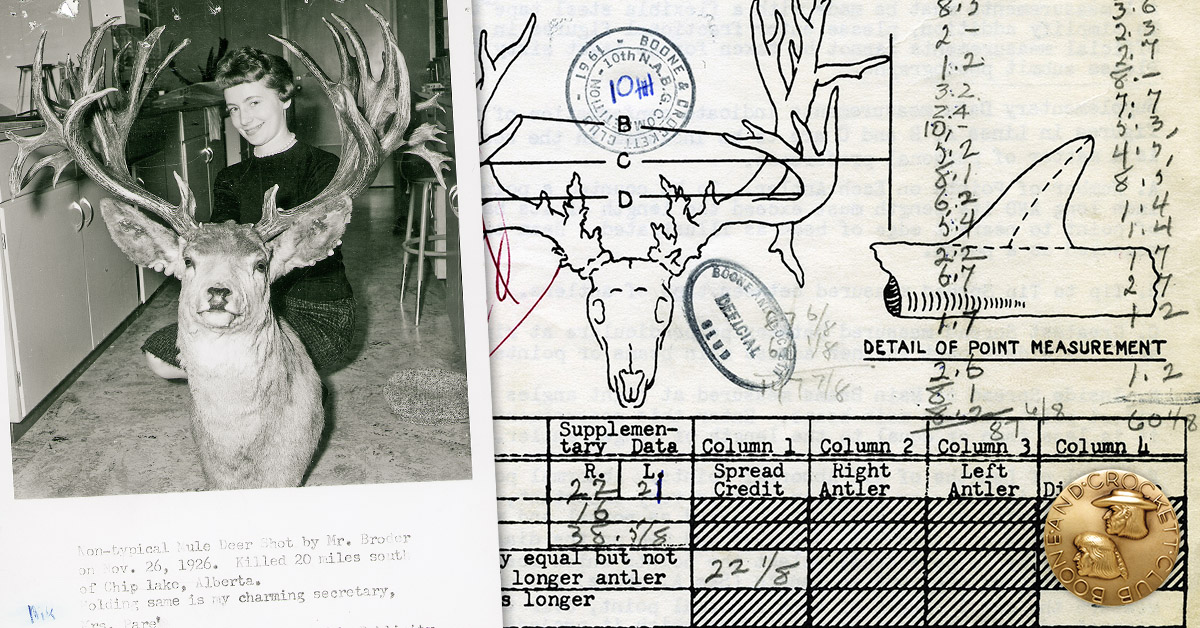
The World's Record non-typical mule deer, taken in Alberta, Canada, is regarded as one of North America's greatest trophy heads, recognition it deserves having held the top spot for more than 90 years.
Alberta produces massive mule deer and the greatest example of that reputation is Ed Broder's World's Record non-typical, which is regarded as one of the greatest trophies ever taken in North America. Broder took this "muley" buck (Odocoileus hemionus hemionus) in 1926 near Chip Lake, Alberta, and offered a colorful account of his hunt.
“On November 25, 1926, I and two friends, driving an old 1914 Model T Ford, left Edmonton for Chip Lake, Alberta, a distance of approximately 100 miles." Broder said. "The weather was 20 degrees Fahrenheit with a foot of soft snow on the ground. At a sawmill camp, near Chip Lake, we hired a team of horses and a sleigh to haul our gear and equipment. Finding a good cabin near the lake, we used this instead of putting up our tent.
I knew I had to select a rear shot. The shot would have to be placed high in the spine, so I pulled up my .32 Winchester Special to a firing position and waited for the buck's head to rise so as to back up a high spine shot. I fired and the animal dropped; I had broken its spine. What a rack that one’s got, was the first thing I thought.”
At 355-2/8 points, the rack's final score replaced the former world’s record by over half as many points. And the antlers may have scored higher if they'd been measured after the initial 60-day drying period—they were not officially scored until 1960. The rack was impressive enough that a drawing of it appeared in the 1939 edition of North American Big Game. Broder acknowledged his record with the determined words of a dedicated and optimistic sportsman—“I started hunting in the year 1909 and have never missed a season since," he said. "I am now 72 and in fair health. Who can tell, I may yet beat my old 1926 record!”